Categories
Art Blog Cinema Feminism gender motherhood

Mother-Daughter and The Unsaid Things/ FILM

By Emily Zou

In my last post on Obachan’s Garden, a Japanese-Canadian documentary, I wrote about how focusing on the stories of mothers and grandmothers is important in disrupting the way that we remember our history and ancestry. For this week’s post, I’d like to write more locally about the wonderful way that a mother-daughter relationship is explored in Greta Gerwig’s 2017 film Lady Bird.

You’ve probably heard of Lady Bird, which made waves three years ago for its painful authenticity; Greta Gerwig’s directorial debut went on to score five Oscar nominations, including Best Picture, Director, and Actress. The consensus is clear: Lady Bird has brought together a ridiculously charming cast and created a captivating vision of Sacramento, all with some of the funniest and most heartbreaking dialogue committed to the screen.

But motherhood and daughterhood is the movie. In fact, the original draft for the film was titled Mothers and Daughters. The title Lady Bird instead refers to the name that our heroine, Christine (Sairose Ronan) chooses for herself, a perfect example of how eclectically rebellious she is. Desperate to fly to the east coast, to find “real culture”, Lady Bird follows Christine in her senior year of high school, as she falls in and out of love, smokes weed, gets into college, passes her driving test and performs in musicals. All the while, she fights with her mother, Marion, (Laurie Metcalf), a father dealing with depression, and coming to terms with her family’s status in a class-stratified society.

While ruminating on having to talk to people about creating her film, Gerwig remarks in a 2017 NPR interview that “most of those people are men. And if they were raised with sisters or if they had daughters, they knew what it was… But if they didn’t, they had no idea that that was how women fought and how they loved, too. I think it was kind of like they were getting to look into a world that they didn’t know existed”. As more women take the helm in moviemaking, stories that only we can tell come to light and are shared. And its movies like Lady Bird, that capture how beautifully painful leaving home and loving it only after you do so, can be. It’s a story that honors motherhood and our homes that was created because of the women’s own experiences.

There’s one scene that really sums up what makes this film so special to me, it goes something like this: Christine is talking about her college essay with a nun, she wrote it about Sacramento, and the nun remarks that you can tell how much she loves the town. No, Christine replies, I hate this place, I just pay attention, but the nun asks, gently, “Don’t you think maybe they are the same thing? Love and attention?” Cut to her Mom, anxiously waiting for her in a thrift store.

See, love is not always gentle, is not always understandable. But the best love is often the kind that perseveres even when it’s not easy, even when it’s not wanted. The realest loves are embarrassing and irritating and overcritical, but you have to love something a lot to believe in it. To love someone not because they are worth loving but because they are someone.

Lady Bird is painful to watch because it’s real. Gerwig has tapped into this very egocentric teenage stream of worries and worries. You change so much in adolescence; you’re in a constant state of shame for some past iteration of yourself and how earnest you were in being that version of you. You’re always cringing because of the things you forgot to love properly or for the things that you didn’t appreciate enough. And of course, you think you know everything, especially once you realize that you don’t.

And so after seeing a version of you (a teenager) portrayed on screen, you have to take a moment to step back from being caught up in your own head and your own worries. You take note of your surroundings, the home you take for granted, and then the people that have become part of your home.

I remember talking about Lady Bird with my mom after we watched it; we were hiking up a mountain and she was displeased that I had watched a movie that deals with sex and homosexuality. She didn’t like it, and in trying to explain why it touched me, I found that there were tears in my eyes as I tried to describe the raw, heartrending ending scene. She pointed out the traitorous evidence of my emotions and laughed at me.

And I guess its moments like that that prove Lady Bird’s point. Gerwig quipped “I don’t know any woman who has a simple relationship with their mother or with their daughter”, and the very messy way we love our mothers and daughters comes across so effectively in her movie.

I don’t even know if I will even be going to campus in the fall (I’ll be a freshman), but I have become acutely aware of this strange, liminal space that I float in, still at home but not really belonging to it anymore. We owe such an existential, unpayable gratitude to our mothers for all of the trouble they went to allow us to live our little lives. I don’t really talk to my mom much these days, but even when we do, whatever I say never seems to be enough to capture just how deeply I am in her debt. How do you even begin to walk around all of the unsaid things?

I haven’t the faintest clue. But I’ll place my faith in whoever is penning my coming of age story, hoping that they’re as fond of me as Gerwig was of Christine. That it’ll all turn out okay, that I’ll finally have the courage to say Thank you.

(Even if it’s only when I’m 460 miles away).

Categories
Art Blog Featured gender health Internships

Vegetables by Aster Woods

Art and Words by Aster Woods – Aster is caregiver to her mother

03/08/2020 10.32 AM Clean Bedroom
03/08/2020 10.52 AM Find Last Night’s Dinner
03/08/2020 10.55 AM Have Difficult Conversation about Vegetables

I want her to eat vegetables. I want her to eat vegetables so much. I have a Pinterest board full of creative ideas for hiding them, or else making them fun; all are designed for fussy children, not adults. My mum has her sense of taste eroded and warped through too many medications. It tastes metallic, chemical, or burns as if it’s causing an allergic reaction. Almost all foods have turned against her, from vegetables all the way to her beloved chocolate oranges. But it’s the vegetables I care about.

Food tastes bad. I know, I know. But you need vegetables, I say. Your body needs these nutrients, now more than ever. She refuses. She will eat: pasta, cheese, fish fingers, and sausages. But vegetables, I say. You always made me eat my vegetables, as a kid when you were taking care of me and not the other way around. I had to even when I didn’t want to and now it’s payback time. I will meet you halfway, I say. I will blend carrots into cheese sauce on your pasta. I will bake onions into a quiche; you might care about them less if they’re smuggled under bacon, if you don’t have to look them in the eye.
It doesn’t work. I’m dying, she says. Why should I care how much worse I get? There’s no being healthy for me. Healthy is not an option for me. I am and will continue to be unhealthy until I die this year or next year. Any time, really. I am suffering enough. Why can’t I do what I want, now? Why does this have to be harder on me?

I spend half an hour angry, then tearful, then angry again.

I understand. I think. She’s got a point; she knows that eating broccoli now will make no difference to a body already eating itself. I know this too. I know I cannot make her healthy again. But I am selfish. I am still the child, her child. Why can’t she do this for me? Doesn’t she owe me something, don’t all mothers owe their children something? For the sacrifices I have made for her, why can she let me feel I am making a difference? If she were my daughter, and I was her mother, I would force her to eat her vegetables. There is a well-published litany of tactics for this. If you eat your vegetables, you will have ice cream for dessert. You’re not leaving the table until you eat your vegetables. I have neither stick nor carrot for her. There is no treat she can enjoy anymore, no punishment I could inflict worse than her existing suffering.

But I’m not giving up. 

Categories
Feminism gender Internships motherhood Queering Parenting

Meet Our New Intern and #Queering Motherhood:

In our ongoing efforts to bring education and practical knowledge together in a place where we can cooperatively learn and grow, MOM is proud to present the work of our newest intern Aster Woods. Aster hails from the Welsh/English border and is interested in museum curatorship, art, caregiving labor, and the notion of #queering motherhood. She contacted us regarding her interest in creating an online body of work around these topics.

The phrase “queering” something has been widely used to deconstruct normative assumptions about individuals and social expectations. By queering something, we are asking people to reconstruct a known definition of something and complexify it, complicate it, and disentangle it from its strict confines. Often motherhood, and the way in which it is performed, is something people are quick to judge and fast to condemn. Some believe that all mothers should only behave in nice, good, and proper ways. But, women who are mothers, are people first, with all their inherent problems, issues, and challenges. When we apply one universal theme to all people we stop seeing them for who they really are, which in turn makes the individual invisible. Below are some excerpts from the book Queering Motherhood, which Aster is reading as she goes through the next several weeks with us looking at this subject.

Essentialism is a sociological theory that reduces a person to their biology, causing unsupported, widely erroneous claims. From the book Queering Motherhood: “Antecedently convinced of biological essentialism, the romanticization of the biological mother-child bond shapes one’s phenomenological experiences of biological motherhood; those experiences then become “proof” of the essentialist hypothesis, making it a difficult hypothesis to dislodge.”P5

i.e. if a person is already convinced of biological motherhood being the only valid form of motherhood, the idealized view of the bond between mother and child forces that person to experience motherhood within that limited parameter (i.e. the biological bond is sacred and mystical) which then “proves” the original hypothesis, making a circular argument that is difficult to break. However, we have, as a society, a wealth of qualitative research and anecdotal evidence that proves that a mother-child bond can be profound to the point of sacredness in fathers and non-biological mothers.

“we may do psychic harm to children who do not live with their biological mothers, causing children who are adopted or raised by another mother to wonder why their real mother failed to exhibit maternal instinct.”P6

5 Reasons Why You Should Never Ask Queer Parents “Where does your baby come from?”

1. It’s invasive! The journey to queer parenting can be difficult, deeply personal and often unique. Respect boundaries.

2. You wouldn’t ask a straight family that. By asking a queer couple, you perpetuate their “othermess.”

3. You imply that their parentage is not valid or real. Their baby is their baby. End of discussion.

4. It’s disrespectful to the baby, too. As they grow older they will develop their own perspectives on their origins, and it should be up to them what they disclose, and to whom.

5. IT’S NONE OF YOUR BUSINESS! Your life will not be impacted by this knowledge in any way, therefore, you have no right to know. If the parents themselves share with you then that’s their choice. But don’t ever ask!

Categories
Art Cinema Feminism gender History International motherhood

Obachan’s Garden – A Look At Motherhood In Cinema

“We think back through our mothers if we are women”– Virginia Woolf, A Room of One’s Own.

By Emily Zou

Obachan’s Garden is a 2001 documentary directed by Linda Ohama, made to honor and remember her grandmother. (Obachan means grandmother in Japanese). Despite this simple conceit, the film takes on a wholly different life as the past is revealed and history is questioned. Moreover, the concepts of what a “good mother” is, are questioned, as well as how different cultural expectations of mothering can clash with each other.

The act of creating film centered on mothers and their experience of motherhood itself disrupts how we are used to learning about history– through our fathers and grandfathers. “Male- centered assumptions about history, as well as feminist ambivalence about motherhood, have complicated the enterprise of searching for mothers in history” writes Jodi Vandenberg-Daves in “Teaching Motherhood in History”. The act of remembering through our mothers offers not a new, but hidden perspective from the past.

“Ryosai Kenbo” is a Japanese word meaning “good wife, wise mother”, introduced during the Meiji period (1868-1912). Based on Confucian ideals of filial piety, it reinforces the idea that women could best serve their country by working at home. This was the ideal that Obachan was raised under, Obachan’s Garden explores how Obachan was trained from a young age to become a housewife, learning languages and dancing. Obachan then relocates to Canada as a picture bride, only to reject her husband the moment she sees him. She works for years to repay him for the ticket to Canada.

Motherhood in Canada was rapidly changing in the pre-World War Two era (when Obachan immigrated), with focus on an idea called the “Good Mother”, where mothering became more “professional”. There were more expectations on what a mother should or shouldn’t do, and the act of mothering became much more heavily scrutinized. A study by Western University explored how advertisements and magazines targeted mothers during this time period, “If mothers indulged their children with too much attention, their children would grow up to be dependent and sissified. Mothers who attended too little to their children’s needs and too much to their own, turned into screaming shrews, and their children became neurotic and fearful. If these precautions were not sufficiently intimidating, the articles also held up mothers who did everything so perfectly that they became unbearable prigs”. It is clear, then, that the way to be a mother was, and still is, heavily influenced by the rest of society.

All of this creates a multi-layered backdrop for Obachan as a mother, a complicated one that is explored through the documentary itself. Ohama paints a picture of a family learning more about their matriarch and her history.

Indeed, the documentary explicitly tells the audience the profound themes the film will explore. “How do we learn about things that have happened before us? And what about memories, what people remember? Are these memories always real?” Narrated over dreamy visuals, Ohama explores how our memory is fallible, how the stories that we hear are always one-sided. Through really getting to know her grandmother, the documentary pieces together a complicated past with motherhood.

In her article examining Obachan’s Garden, Sheena Wilson writes that “the telling of mother-stories can be reclaimed as an act of resistance, whether mothers are telling their own stories, or daughters and granddaughters are retracing their matrilineal genealogies”. We need more of these stories to “think through our mothers,” to see our history from their point of view.

Sources:

Fullerton, Romayne, and M.J. Patterson. “Procrustean Motherhood.” FIMS Publications, 2010.

Larsen, Robert. “Ryousai Kenbo Revisited.” Hastings International and Comparative Law Review, vol. 24, no. 2, 2001.

Wilson, Sheena. “Obachan’s Garden.” Demeter Press, 2016.

Read about Emily’s Remote Internship with MOM: Reviewing Motherhood in Cinema [CLICK]


Categories
Art Cinema Featured Feminism gender motherhood

Motherhood in Cinema

By Emily Zou

“Motherhood studies as an area of scholarship is on precarious ground”, Samira Kawash warns in her article New Directions in Motherhood Studies. Advocacy for mothers and the study of feminism are inextricably linked, yet the study of motherhood has been largely neglected by the feminist movement. There are numerous reasons for this (which Kawash elaborates in her article), including the desire to remain separate from conservative “family values” and changing feminist theory. It will take years and a lot of work for this field to be more broadly recognized.

So this is that: the years and the work.

Through the next few weeks, I hope to understand and discuss films through a lens of motherhood studies, or as museum founder and scholar Martha Joy Rose elaborates “Mother Studies” citing motherhood as an institution, mothering as an act, and mothers as the persons at the center of this discourse. But, before we begin, I would like to explain why I feel studying both cinema and mothers is important.

There are three main reasons as to why film is worth thinking and writing about. The first is the most obvious: cinema has an audience, and the messages portrayed onscreen have real life impacts. Franklin Fearing wrote in 1947 that “motion pictures achieve their effects because they help the individual to cognize [their] world.” This still holds true today; anyone who has seen a film knows that it is not a passive experience, it is an interaction. Cinema allows us to peek into worlds that we could never imagineThey also can change our minds; a 2015 study from the University of Dayton found that 25% of participants changed their stance on the government after watching Argo and Zero Dark Thirty. The ideas expressed in movies are of consequence– they shape how we see the world. This is why so many people campaign for diversity onscreen and fight for more female directors. Accuracy in visibility is key to the millions of people who come in contact with these ideas.

So, studying fictional mothers is important because of what they mean to their audience. Of the influence of the portrayal of mothers in cinema, Asma Sayed writes in “Intersection Interventions in Global Cinema”:  “–are these mothers good? How quickly are they able to reclaim their pre-baby bodies? How do they balance work and mothering? Such questions are a reflection of societies in which, historically, a woman’s primary role has largely been defined by her ability to bear and rear children.” The representation of the maternal figure on screen both reinforces and is produced by societal values.

But motherhood, mothers, and their portrayal onscreen reveal much more about society. Like how Sherlock tells us that oceans can be deduced from a drop of water, a singular film can provide insight into the context of the world that made it. Why it was created, how it was created, how people responded to it, and all of its intentional and unintentional effects can be profound and impactful. Jennifer Wingard’s article “(Re)Producing Globalization: The Labouring Body in Maria Full of Grace links how capitalism and imperialism affects the bodies of mothers in the film Maria Full of Grace. Sayed aptly summarizes Wingard’s article: “It is important to follow the movement of Maria’s body not only to understand how women’s bodies affect and are defined by the contradictory flows of global capital, labour, and migration but also to see the limited range of choices available to women navigating within this system. Wingard points out how women’s labour is not recognized as part of economic production, even though it is essential to sustaining the global economy.” fictional mothers may not always be explicitly metaphors for any socio-cultural commentary, but the idea of the maternal and how it relates to those issues are still expressed through them.

Intersectionality is essential to creating an inclusive environment to learn about motherhood, which varies across race, class, and culture. Family dynamics are constantly changing across the world. Samira Kawash remarks that “…we need to broaden our awareness and understanding of the diverse positions and meanings of motherhood. Feminist scholarship on motherhood in the past decade has focused attention on the various ways in which mothers cannot or will not submit to the (white, middle-class, heterosexual) norms of good mothering.” So, not only can mother characters reveal infinitudes about the world, but we must expand our study of mothers of all kinds, from all around the world.

My last and most romantic reason is that the appreciation of art is what makes this life meaningful. There’s this quote that I love by Donna Tartt: “Beauty alters the grain of reality.” She was describing paintings, but this idea applies to all forms of the sublime that we are lucky to experience on Earth. The cinematic experience is a wonderful one, and I am  excited to reinterpret them over the course of the next months.

As a final note, I would like to bring up the idea Kawash concludes her article with, that “feminism cannot possibly hope to remain relevant without acknowledging motherhood in all its contradictions and complexities.” It is only through understanding mothers and the way we treat them that we can hope to advocate for gender equality without leaving our mothers behind. We must embrace the many forms that mothering can take in order to uplift and honor the legacy of the generations of mothers that have largely gone forgotten and misrepresented.

*side note: In Kawash’s article, she writes “One positive development is a new Museum of Motherhood, “a real and virtual social change museum focused on amplifying the voices and experiences of mothers while connecting ‘the cultural family,’… there is also an opportunity, not only in the Museum of Motherhood but in the broader field of popular and academic investment that the museum seeks to make visible.”

Categories
Featured Feminism gender History International MOM Art Annex motherhood Sociology USF

The Founding Mothers: Women in Herstory

This month marks the International celebration of Women’s Day (Sunday, March 8) and Women’s History Month.

Both of these acknowledgments demonstrate an earnest desire to understand and honor the contributions of women. Wednesday, March 11th will mark the opening event for a new exhibit at USF, Women’s and Gender Studies Dept., curated by Martha Joy Rose.

Panels featuring the four waves of feminism flank the entrance to the exhibit titled The Founding Mothers: Women in Herstory. Also on exhibit are a myriad of art pieces including works by Rose, Christen Clifford, and Kim Alderman. This timely installation brings together feminist voices throughout herstory who have challenged conventional attitudes about gendered performance and motherhood through their writing, activism, and art. A multi-media interactive exhibit encourages participants to think critically about evolving family narratives and womyn’s place in society.

Please do come visit. See the impact Mother Studies can have on your life, perspective, and the future. Write INFO@MOMmuseum.org for more info. Flyer for the opening event is here. The exhibit will be up through May 8, 2020.

See more panels here online at the Museum of Motherhood: LINK

Categories
Art Classes Conferences Education Feminism gender International USF

CFP (MOM Conference 2020) Embedded in SEWSA, USF St Pete

(USF) Women and Gender Studies is pleased to host the 2020 SEWSA Annual Conference in Tampa Bay, Florida, St. Petersburg Campus Location. The Annual MOM Conference Panels will be embedded within this conference.

Friday, March 27th – Come visit the MOM Art Annex display in the Exhibition Hall at the USF St. Pete Campus!

This year’s theme—figures embodiment and diverse lived experiences as the lifeblood of resistant politics and the livelihood of building alliances across our many differences. The theme echoes the broader mission of the interdisciplinary field of Women’s and Gender Studies (WGS). With its distinctive blend of research, programming, teaching, and advocacy, WGS questions conventional wisdom, challenges the status quo, critiques intersecting gendered, sexual, and racialized inequities and injustices, and strives to create social change for more equitable, ethical, and just futures.

Our theme takes special inspiration from the work of feminists of color and their allies— including early abolitionists like Sojourner Truth and Harriet Tubman, civil rights activists such as Fannie Lou Hamer, Septima Clark, and Rosa Parks, groups such as the Combahee River Collective, writers and teachers like Audre Lorde, June Jordan, Mitsuye Yamada, Cherrie Moraga, and Gloria Anzaldua, The Movement for Black Lives, founded by Alicia Garza, Patrisse Cullors, and Opal Tometi, the #sayhername campaign, the reproductive justice movement, and the work of researchers and theorists such as bell hooks, Angela Davis, Kimberle Crenshaw, Lila Abu-Lughod, Emma Perez, Saidiya Hartman, Gayatri Spivak, Dean Spade, Jasbir Puar, Fred Moten, C. Riley Snorton, and the late Saba Mahmood, among many, many others. The work of these scholar-activists is a source of critical insight into the workings of what the Combahee River Collective called interlocking systems of oppression, and a reminder that disobeying unjust state logics and challenging administrative and other forms of violence is literally a matter of life and death, more so for some populations than for others. For this reason, so too do these trailblazing and cutting-edge activists and scholars prompt us to recall the imperatives of self-reflexivity, critical positionality, and situated knowledges in confronting inequality and injustice from a variety of intersectional and transnational perspectives.

In these ways and others, our theme invites a wide range of interdisciplinary critical engagements with the body politics of disobedience. How, for instance, do different forms and modes of racialized and gendered embodiment inform strategies of disobedience to state regulation, the criminalization and dispossession of multiply- marginalized populations, and the ongoing upward redistribution of wealth and resources under neoliberalism? At the same time, the theme invites consideration of how to better craft stronger and more capacious affinities between counterhegemonic projects, for example, between The Movement for Black Lives, disability justice activism, struggles for indigenous decolonization, trans and intersex rights, prison abolition, and intersectional feminist, queer, and anti-racist research and activism. “Embodying Disobedience, Crafting Affinities,” then, seeks to emphasize the continuing import of multi-issue politics in efforts to move beyond commodified notions of allyship towards relations of radical solidarity and mutual interdependence.

In the current historical moment we are witnessing unprecedented interest in feminism and a resurgence of activism in the same space as increasing white nationalist, anti-trans, anti-immigrant, and anti-choice rhetoric, policy, and legislation. In such a climate, this year’s SEWSA takes the opportunity to draw insight and inspiration from the past and chart a course toward different, hopefully more just—and perhaps also more queer— futures. As 2020 marks the 59th quadrennial presidential election, the centennial of the 19th Amendment, and the fiftieth anniversary of the first women’s studies program, we want to remember the ways in which women’s studies has linked theory to practice, not only to transform the present but also to know the past differently and to imagine and create a world beyond it. Women’s studies, from its inception, ranged across the disciplines, found resources where it could in the name of survival and resilience, and insisted on forms of interdisciplinary inquiry that today demand questions of gender, race, and sexuality to disrupt the naturalized status quo. Women’s and Gender Studies, at its best, embodies disobedience—to the disciplines, reigning ideas of sex and gender, the nation, racial capitalism, and single-issue politics—while simultaneously fighting to craft political and intellectual affinities that will make a difference in the world.

Categories
Birth Classes Dads Featured gender health History manhattan college Medical motherhood Policy Sociology

Sociology Opens Our Eyes to New Ways of Seeing the World!

This summer, extreme weather rocks America and pundits debate while August arrives all too quickly. Since July 1st, accounting majors, economics majors, and students of literature have been increasing their knowledge and vocabulary about important issues that affect us all by studying sociology. These students are hard at work exploring theoretical assertions about race, class, and gender in an online summer intensive Introduction to Sociology course, specifically framed around the Sociology of Family.

Using texts that explore gestation, birth, and caregiving, authors Barbara Katz Rothman, Phyllis Chesler, Patricia Hill Collins, and Keisha Goode (to name a few), explore women’s experiences, racial disparities, and gendered labor. This week, we read the latest media stories on wombs, trans-birth, uterus transplants, and self-identified men as mothers. We have all been scrambling for new definitions and fresh ways of thinking about gestation as well as parenting.

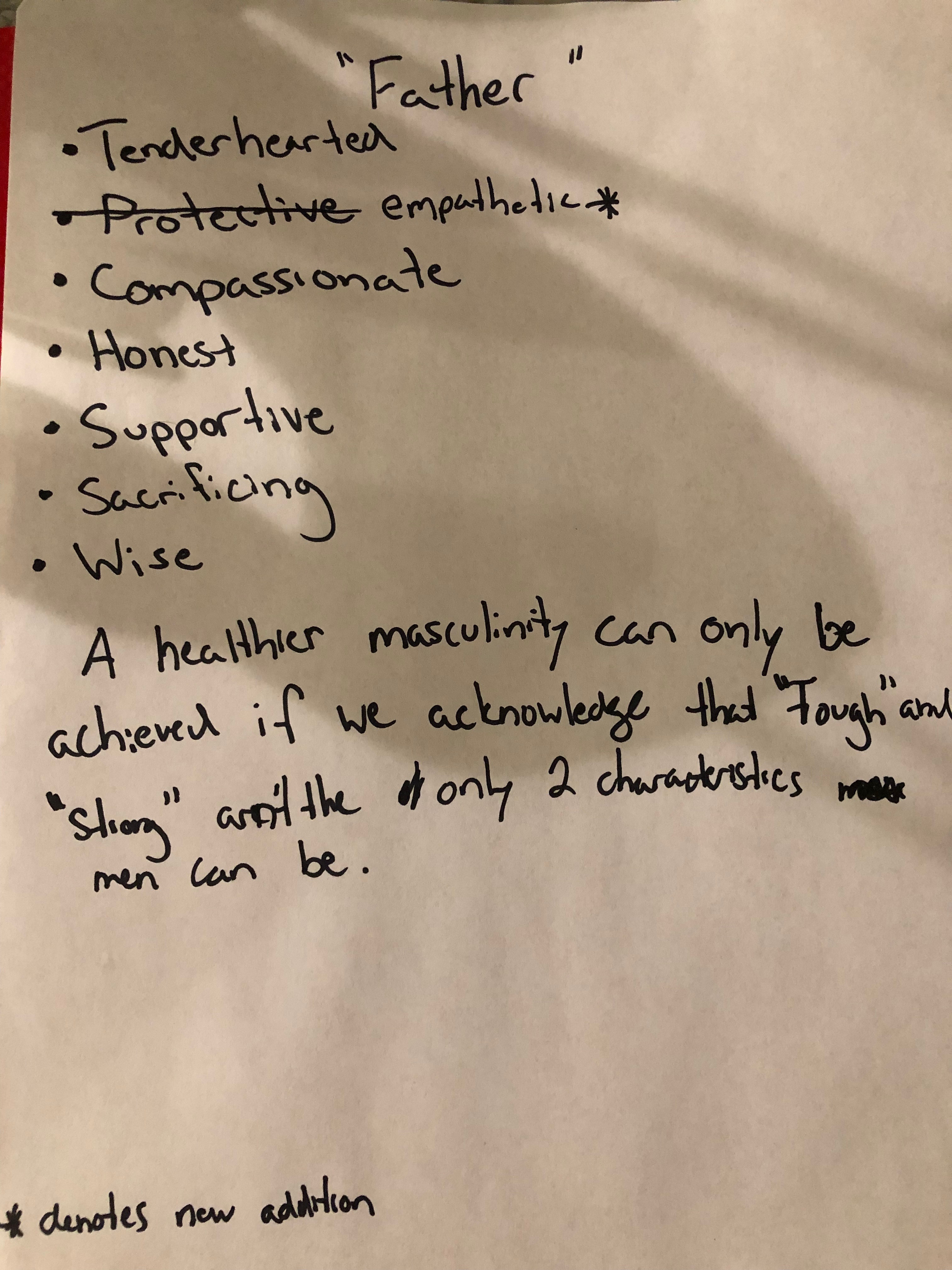
As part of a service-learning portion of an Intro to Sociology class, students were asked to take a piece of construction paper or plain white paper and mark in bold words a minimum of 5 words that best describe “mother” and “father”. We have been complicating those basic notions ever since.

Thinking about the authors we are studying assert about biology and gender, coupled with recent medical and policy developments, motherhood is more complicated than ever! The students were invited to revisit their original posters and articulate some of the information that has influenced their perspective in recent weeks. Some of their notes are below:

Words Added:

–       Gender Neutral:

·      The readings from this week highlighted the problems associated with gendered parenting

·       Mothers struggle with work because of the perception that they are obligated to care for their home and children

·       Men do not feel obligated to do any parenting work but feel an overwhelming obligation to provide economically for their families

·      Both genders are equally capable of parenting in the form of motherhood and fatherhood

·      everyone including children would be better off if parental duties were split equally

·      All other words on the poster represent things my mother, grandparents, and stepfather did and that I wish my father had participated in

·      Not parenting is a personal choice not a gendered choice

–       Parent:

·      Added for reasons listed above

·      Parent should imply the same duties regardless of the parent’s gender

       Present:

·      Being present is an essential part of parenthood that I did not think about until I watched “Glen Henry got his Superpowers Through Fatherhood”

–       Care:

·      “Mothering is most likely done by a female due to our society’s definition of the word ‘mother.’ The action of mothering however is simply caring for another.” [Castaneda and Oware]

–       Guide

–       Educate

·      Guide and educate were both terms I did not think to put until I though in the context of parenthood rather than motherhood

·      Gendered expectations affect us all and are very pervasive

Assertion Statement:

Replace motherhood and fatherhood with parenthood

Father
• Tenderhearted
• Empathetic
• Compassionate
• Honest
• Supportive
• Sacrificing
• Wise
“A healthier masculinity can only be achieved if we acknowledge that “Tough” and “Strong” aren’t the only 2 characteristics men can be.”

Categories
Birth Blog Education Featured gender health Medical motherhood Sociology

TRACKING THE COURSE OF MUTINY AGAINST THE TYRANNY

Op-ed, Martha Joy Rose May 13, 2019 

Despite headlines and discourse, the most unchanging thing about motherhood is how much it doesn’t change. While parenting narratives in the public arena are more visible than ever, while books on mothers and mothering are written and published at a dizzying pace (see Demeter Press among others), and while activists and bloggers do their best to articulate the realities and difficulties of mothering, the truth will make you mad. Policies ranging from healthcare to human rights in the United States have not changed much at all in the last 50 years, and if anything, they appear to be moving backward at times.

This year’s Mothers’ Day came and went with the usual fanfare of compliments, cards, and lovely acknowledgments. But, the truth of being a woman, or a woman of color in America, can be very scary. Aside from the well-known, repetitive conversation around everything from our as-of-yet still unratified ERA to maternal morbidity rates, we observed a rollback of certain state’s abortion rights, and the constant pressure mothers and caregivers experience as they try to balance unrealistic expectations with work pressures. All of this occurs in the midst of corporate greed and governmental callousness which is reflected in our lack of family-friendly policies.

‘All The Rage’ Isn’t About Moms Having It All — It’s About Moms Doing It All’

NPR: Weekend Edition, May 12, 2019

On why domestic demands on mothers actually increased in the mid-’90s

The expectations for motherhood suddenly … went through the roof. … One of the reasons that academics will cite for why this happened at the same time that [mothers’] labor force participation peaked was because there was a lot of anxiety about what was going to happen to the kids. All these moms are now in the workforce in greater numbers than ever: What’s going to happen to the children? So the standards for mothering kind of ratcheted up. [Link to ARTICLE].

Feminism & Motherhood

As a woman, I am angry. But as a mother, I’m seething. There’s a robust conversation right now about the historical and present power of female rage as a tool for social change. A number of books, articles, and social media hashtags are pointing out that women are fed up. Instead of being silenced by patriarchal ideas of women’s emotions as “hysteria,” women are embracing their anger as a social and political force to be reckoned with. That is great news for women. But what about mothers as a key subset of women? ~Kimberly Seals Allers for The Washington Post 2019: [LINK to article]

There is a lot to be angry about. Women of color in the USA, who are pregnant, have the most to be worried about. Their prenatal care, birth care, and post-birth care are all persistently worse than their white counterparts. This problematic scenario can be linked to many ongoing issues related to systemic racism, socio-economic status, and the apparent lack of willingness for medical professionals to listen to the voices of these women. [Read more here in the news at this link].

This year’s Museum of Motherhood annual conference focused on “Rewriting Trauma and Birth.” We welcomed keynote speaker Khiara M. Bridges, who is the author of Reproducing Race. Her book smartly explores the social construction of race in medical settings and helps to examine the forces that coerce women into dangerous birth scenarios.

So, whether over-burdened by maternal workloads, subject to a medical crisis of deadly proportions or managing the anger associated with outdated policies that do not support women and families, something has got to shift.

Before we can identify solutions we must notice the problems and call them out. By naming and labeling the issues we have engaged in the first line of offense. Some people will voice objections. They will list the ways in which gender mirrors biology. They will do their best to keep enduring structures of power and privilege intact. However, we just keep raising our voices and turning up the volume.

Kimberly Seals Allers proposes several steps for improving the state of families in America. Some of those include obvious changes to healthcare. Others must focus on policy shifts that recognize unpaid maternal labor, as well as the development of affordable childcare options for working mothers.

So what has been going on for the last 15 years? Below is an article that was written by Jill Brooke for the Chicago Tribune during a burst of notoriety for the Mom Rockers who had set their minds on creating change within the home as well as the world at large. While the emphasis on using art and music for social change has amped up the volume on women’s issues, many of the problems these founding artists sought to address have remained stubbornly ingrained in our institutions, including the “institution of the family.” You can read more on this subject in the book, the Music of Motherhood (Demeter Press 2018).

Course development and educational programming that break the barrier on women’s (and gender) studies in the university and beyond are an important step in disrupting repetitive patterns that keep individuals trapped in hegemonic discourses and force the idealization of parenting roles. Here at MOM, we are striking back by pushing back. Giving a nod to the work of Guerrilla Girl Donna Kaz, we encourage those of you who are seeking some strategies for change to utilize her work to create activist platforms. LINK

” I have heard many people express their own powerlessness as they face threats to their rights and the rights of those they support on a daily basis. Perhaps you agree there is a need to understand how to organize and see results, on a local level. Maybe you search for activist knowledge and are hungry for something to guide you through the steps of creatively supporting a cause. PUSH/PUSHBACK will fill that need.”

The band Housewives On Prozac was championing pushback through music in the late nineties through 2008. Their song “Eat Your Damn Spaghetti” was a rallying cry for overwhelmed and frustrated mothers. You can watch the video below. Meanwhile, the MaMaPaLooZa Festival, which is ongoing in New York City and Sydney, Australia aims to create dynamic change through empowerment, education, and large-scale community events. Other super-important and amazing organizations (to name a very few), include MomsRising, SisterSong, and The Center for Reproductive Rights.

TRACKING THE COURSE OF MUTINY AGAINST THE TYRANNY OF PARENTAL EXPECTATIONS

December 21, 2004,|By Jill Brooke, Special to the Tribune

“I tried to be the perfect mom but then buckled. It’s time for a little liberation, and I want to give moms permission to nourish a piece of themselves and then go back to wiping the kids’ noses, cooking dinner and carpooling.”

And what better way to launch a rebellion than rock ‘n’ roll? Link to ARTICLE.

Finally, let us ask the question: Why does America have the least-friendly family policies? The U.S. is the only country in the Organization for Economic Cooperation and Development (OECD) not to offer paid leave on a national basis.

“People think motherhood is inherently overwhelming because we’ve made that idea seem natural,” said Virginia Rutter, a professor of sociology at Framingham State University in Massachusetts and author of “Families as They Really Are.” “We normalize the hardships of motherhood. … This is now what’s familiar.”

LINK to article

We must continue to work together for the kinds of change that will benefit all American families and not just a few. The best way to do this is to advocate for intersectional, interdisciplinary education and activism that affects attitudes, policy, and the private/public sector in ways that support women and men and make the world an easier place for caregivers to navigate.

*Mamava is a company that hopes to normalize breastfeeding and support nursing mothers. One of their lactation spaces in JFK airport is the featured photo on this post. #Mamava #Mothers #MOM #JoinMama

Categories
Art Featured gender MAMA

M.A.M.A. Issue 36: with ProCreate Project and Csilla Klenyanszki

Csilla Klenyanszki was born in 1986 in Budapest, Hungary. She completed her BA Photography at the Willem de Kooning Academy in Rotterdam, the Netherlands in 2012. In 2014 she participated at SeMa Nanji Artist in Residency by the Seoul Museum of Art at Seoul, South Korea. 

​After becoming a mother in 2015, Csilla has founded Mothers in Arts Residency in 2016. Mothers in Arts Residency (www.mothersinarts.com).

​Csilla’s work has been exhibited nationally and internationally. She has recently won the Still life prize at the 33rd Festival International de Mode & de Photographie in Hyères, France and her first (dummy) book “Pillars of home” is shortlisted for Unseen Dummy Award 2018.

“A search for balance with a problem-solving attitude characterizes my work. Within my current practice, I carefully examine and deconstruct personal – but universally known – challenges such as parenthood, gender, and the malleability of self-identity through the passage of time. Works, such as “Pillars of home”, “to make time”, “House/hold” or the “Mothers in Arts Residency” aim to give solutions that range from the practical to the absurd.

Although my approach is analytic, the nature of the work is highly playful and experimental. To give a new perspective I often play with the borders of nonsense with a constant attraction to physical and mental tension.”

house

—-

hold

“House/hold” is part of a research project on women’s position in western society. It examines the evolution of gender equality in various subjects.“House/ hold” investigates the housework gap and its consequences while it provides an ironical solution for women: a 30-minute yoga session combined with domestic chores.

The session transforms the house into a space for meditation using domestic objects as its basic elements. Housework is being transformed into illumination: the repetitive act of house making becomes not just a physical but also a mental and spiritual act where women and their household objects become entangled. “House/hold” is a guide for domestic meditation.

_______________________________________________________________________________________

Csilla Klenyanszki

Since the 1960s there have been lots of achievements in the path to gender equality in western society: The gender wage gap narrowed: In 1979, women working full time earned 62 percent of what men earned; in 2014, women’s earnings were 83 percent of men’s1. The number of women in the labor force with a college degree tripled: from 11.2 percent to 40.0 percent2. Woman don’t have to choose between a career and having children: while in the 1950s only 17 percent of mothers were in the labor force, in 2005 more then 60 percent of mothers with preschoolers had a paid job and 75 percent of mothers with school-aged children were working3. And yet, certain things didn’t change that much.

Due to industrialization and the proliferation of domestic appliances the amount of household chores done by women has dropped. On the other hand, the gap in housework distribution between men and women didn’t shrink that much and even worse since the 1990s it has been shrinking at a slower pace.

In the Netherlands, according to the Dutch Sociaal en Cultureel Planbureau (SCP)4 women spend on an average 9 hours more on housework than men.

In households with children this gap is even bigger: According to SCP, Dutch mothers spend1 an average of 20,6 hours a week fulfilling domestic chores and 4,4 hours on childcare and mothers with children under the age of 3 years spend 18 hours a week on childcare and 20,6 hours on domestic chores: 15 hours more than men. According to The Second Shift written by Arlie Hochschild, mothers do at least a month unpaid work more in a year than fathers.

One of the consequences of this housework gap is that women have access to less leisure-time than men simply because they spend more time in unpaid work such as domestic chores and childcare. According to the ONS5 women spend 5 hours less on leisure than a man on a weekly basis. The survey has also found that time spent on leisure has risen for men and dropped for women since 2000.

1 https://www.bls.gov/opub/reports/womens-databook/archive/women-in-the-labor-force-a-databook-2015.pdf 2 https://www.bls.gov/opub/reports/womens-databook/archive/women-in-the-labor-force-a-databook-2015.pdf 3 https://stats.bls.gov/opub/mlr/2007/02/art2full.pdf
4 https://www.scp.nl/Publicaties/Alle_publicaties/Publicaties_2013/Met_het_oog_op_de_tijd

5 https://www.ons.gov.uk/economy/nationalaccounts/satelliteaccounts/articles/leisuretimeintheuk/2015

MAMA_Logo_2015

The Museum of Motherhood, the ProCreate Project, the Mom Egg Review, and the Mother Magazine are pleased to announce the launch of a bi-monthly international exchange of ideas and art. M.A.M.A. will celebrate the notion of being “pregnant with ideas” in new ways. This scholarly discourse intersects with the artistic to explore the wonder and the challenges of motherhood. Using words and art to connect new pathways between the creative, the academic, the para-academic, the digital, and the real, as well as the everyday: wherever you live, work, and play, the Art of Motherhood is made manifest. Download the Press Release here or read about updated initiatives#JoinMAMA  @ProcreateProj  @MOMmuseum @TheMomEgg