A contemporary gaze into feminist art is both subjective and objective, either from female artists or social collective lenses. Lucy R. Lippard stated in 1980 that feminist art was ‘neither a style nor a movement but instead a value system, a revolutionary strategy, a way of life.” Staring with “ME” (the individual), and “WE” (the community), to “WOMEN” (the entire female as half the population), a sequential contemplation focusing on various perspectives and creativities from female artists worldwide is highlighted. Eleven female artists from different nations and cultural backgrounds bring us the reflection of how contemporary feminist art shapes life and art from diverse angles yet to reach a pluralistic interconnection. This project is a part of the MOM Internship Program with Li Yang.
Trish Morrissey, (born 1967 in Ireland; lives and works in London) graduated in photography at the University of the Arts in London in 2001. Her work mainly relies on photography by simulating a specifically constructed reality, playing on the binary pair: truth/ representation. Trish Morrissey’s photographs become an instrument to criticize and question family unity and its quintessential manifesto, the family portrait that displays similarities, proximities, hierarchies, and inner orders.
”Since 2012 I have been mostly working with archives and collections. I am passionate about stories of women that are often overlooked in history, in favour of male-centered narratives. I am excited by the small details of people and their lives, things that are often universal and ageless. I am drawn to stories of eccentricity and my way of sharing this is to get under the skin of places, and people. I develop and play characters that I hope are authentic and recognisable. They sometimes lie on the border between psychologically disturbing and a little bit funny. I have several projects happening right now, but the biggest one is a survey show opening in Serlachius Museum, Finland in February 2022. This exhibition will includephotographs and films from the last twenty years alongside new work inspired by my studies in the museum’s archive.”Her work is exhibited widely, most recently at Recent exhibitions are Group Shows: ‘Landscape, Portrait: Now and Then’ at Hestercombe Gallery 2021; ‘Who’s Looking at the family now?’ at London Art Fair 2019 and solo show ‘Trish Morrissey: A certain slant of light’ at Francesca Maffeo Gallery, 2018.
Her work is in the permanent collection of The Museum of Fine Art, Houston, Victoria and Albert Museum, London, The National Media Museum, Bradford and the Wilson Centre for Photography, London
October is a harvesting celebration month. This October report describes some of my research and areas of interest on the topics of American Indians. Among them, are ethnobotany (in traditional acorn gathering) and Ecofeminism. Through my internship at MOM, I look forward to exploring the Indigenous lifestyles as I work toward the completion of my advanced degree in Public History at American Public University (full Bio online at Padlet). In particular, I also interested in the Chumash tribe, whose peoples populated central California until the establishment of the Spanish missions in the 1700s. Chumash tribe’s encounters are brief, the Indigenous information shared with Mother’s museum will come from extensive research.
My October report begins with a youtube video called, “A Conversation with Native Americans on Race”, which was suggested to me by museum director, Martha Joy Rose. This youtube video emphasizes American Indian identity and loss. The first interviewee remarked on how tribal populations were treated extremely poorly. Each of the interviewees had a slightly different perspective about terminology. But, based on the recommendations made, the term “American Indian” was preferred over Indigenous people. So, that is how I will henceforth make reference. According to his explanation, identity is valued, and “American Indian” refers to the culture (in general). Click on the image below if you would like to watch the video in its entirety.
Early attempts at Christian conversion aimed at removing the American Indian culture and identity have left deep scars. Further research about the California Chumash tribe and lifestyle provided historical depictions of life during the mission period. The Mission San Luis Obispo de Tolosa describes the missionary padres replacing the American Indian mother’s role as gathers. The padre’s lessons were instructions for farming and architecture building. Despite the padre’s efforts, the Chumash tribes continued their cultural traditions in festival celebrations and herbal trades. It is important to note, that American Indians have been disproportionately affected during COVID- with extremely high mortality rates.
In addition to the ongoing devastation of COVID, California (and now Colorado) wildfires have been burning at unprecedented levels. I accessed a segment about Native American cultural burns that historically encouraged diverse natural habitat and helped to control forest fires. I was also able to watch Kat Anderson’s “Tending the Wild”, a television documentary about the practice of motherhood acorn gathering traditions. The mothers’ role in the American Indian’s acorn gathering traditions is joyful. As if to counter the great obstacles currently facing not only Native Americans but all Americans in 2000, Kat places emphasis on Indian gathering activity as a heartful participation in cultural mindfulness. Her contributions in “Tending the Wild” encourage this tradition as well as ecological knowledge. She states, “these practices are essential if we are to completely utilize the living sustainable challenge”.
This connects to Kim Anderson’s article “Giving Life to the People”, which describes the spiritual aspects of Motherhood. She describes Native American Mother’ beliefs in the ability to maintain life’s creations. Kim cites Paula Guen Allen’s scholarly, spiritual tradition descriptions, stating “There is a relationship between creative thinking and the power of mothering.” She continues, “Mothers are connected to the original creation and the work in progress for a sustainability aspect.” Kim highlights this concept with anthological and petrograph studies and evidence. The Native Americans truly believe the Earth is the Mother of all life. She writes” Therefore, Women’s power is viewed in the ability to create and nurture.” The book featuring Kim Anderson’s essay is available at the Museum of Motherhood library (Maternal Theory, Essential Readings, edited by Andrea O’Reilly).
Kathryn Mile’s “Ecofeminism” and Mary Mellor’s “Feminism & Ecology” articles provide Ecofeminism descriptions and views. Kathryn describes ecological feminism as a branch of feminism that examines the connections between women and nature. This is a world view that respects organic processes, holistic connections, and the merits of intuition and collaboration. These protectives illustrate ecofeminism connecting both a commitment to the environment and an awareness of the associations made between women and nature. Mary Mellor agrees with these Ecofeminism concepts. She highlights, “Ecofeminism brings together the feminist elements and green movements.” She continues, “Ecofeminism, a ‘new term for an ancient wisdom’s that arose from various feminist, peace and ecology movements”. In the early 1980s, Francoise D’Eaubonne first used the Ecofeminism term. This gained popularity in protests against environmental destruction.
During my eco-feminism and acorn research, I found Acorn Recipes, which are close to the Native American bread-making traditions. I would say many of these have been modernized and do not look authentic, but I would still like to experiment with the recipe sometime. Actual acorn flour can be quite bitter and requires several soakings before pounding the material into pulp. Here is a link to more information about how to do that [LINK].
Mix cornmeal with cold water, add boiling water and cook 2 minutes, stirring constantly. Add sale and butter and cool to lukewarm. Soften yeast in lukewarm water. Add remaining ingredients to corn mixture, along with yeast. Knead to a stiff dough. Dough will be sticky. Cover and let rise in warm place until doubled in bulk. Punch down, shape into two loaves, cover and let rise until doubled in bulk. Bake at 375 degrees for 45 minutes.
Anderson, M. Kat. “Tending the Wild: Native American Knowledge and the Management of California’s Natural Resources.” Berkeley, CA: University of California Press, 2006.
Anderson, Kim. “Giving Life to the People: An Indigenous Ideology of Motherhood.” In Maternal Theory: Essential Readings, edited by O’REILLY ANDREA, 761-81. BRADFORD, CANADA: Demeter Press, 2007.
This summer, extreme weather rocks America and pundits debate while August arrives all too quickly. Since July 1st, accounting majors, economics majors, and students of literature have been increasing their knowledge and vocabulary about important issues that affect us all by studying sociology. These students are hard at work exploring theoretical assertions about race, class, and gender in an online summer intensive Introduction to Sociology course, specifically framed around the Sociology of Family.
Using texts that explore gestation, birth, and caregiving, authors Barbara Katz Rothman, Phyllis Chesler, Patricia Hill Collins, and Keisha Goode (to name a few), explore women’s experiences, racial disparities, and gendered labor. This week, we read the latest media stories on wombs, trans-birth, uterus transplants, and self-identified men as mothers. We have all been scrambling for new definitions and fresh ways of thinking about gestation as well as parenting.
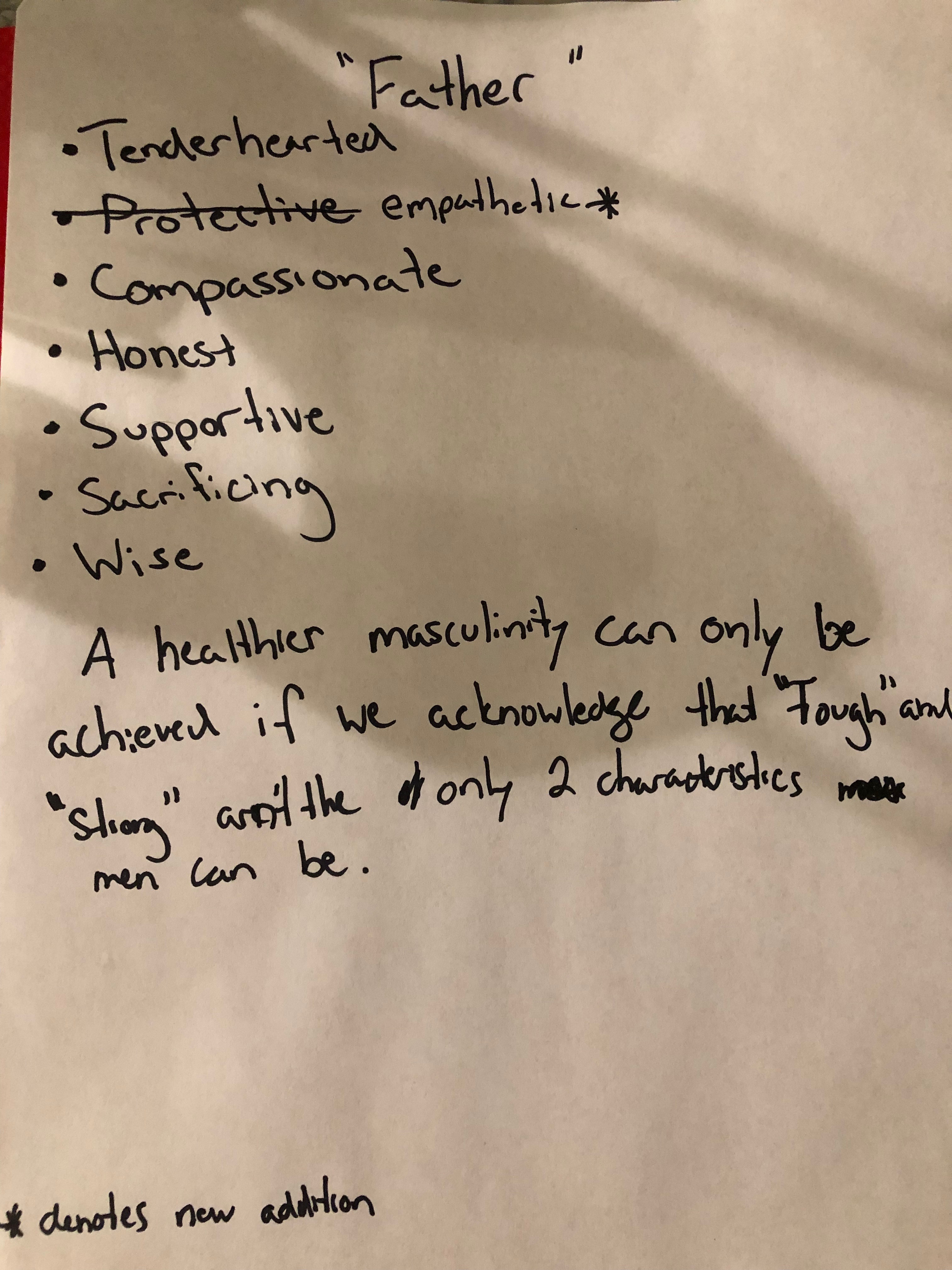
As part of a service-learning portion of an Intro to Sociology class, students were asked to take a piece of construction paper or plain white paper and mark in bold words a minimum of 5 words that best describe “mother” and “father”. We have been complicating those basic notions ever since.
Thinking about the authors we are studying assert about biology and gender, coupled with recent medical and policy developments, motherhood is more complicated than ever! The students were invited to revisit their original posters and articulate some of the information that has influenced their perspective in recent weeks. Some of their notes are below:
Words Added:
– Gender Neutral:
· The readings from this week highlighted the problems associated with gendered parenting
· Mothers struggle with work because of the perception that they are obligated to care for their home and children
· Men do not feel obligated to do any parenting work but feel an overwhelming obligation to provide economically for their families
· Both genders are equally capable of parenting in the form of motherhood and fatherhood
· everyone including children would be better off if parental duties were split equally
· All other words on the poster represent things my mother, grandparents, and stepfather did and that I wish my father had participated in
· Not parenting is a personal choice not a gendered choice
– Parent:
· Added for reasons listed above
· Parent should imply the same duties regardless of the parent’s gender
– Present:
· Being present is an essential part of parenthood that I did not think about until I watched “Glen Henry got his Superpowers Through Fatherhood”
– Care:
· “Mothering is most likely done by a female due to our society’s definition of the word ‘mother.’ The action of mothering however is simply caring for another.” [Castaneda and Oware]
– Guide
– Educate
· Guide and educate were both terms I did not think to put until I though in the context of parenthood rather than motherhood
· Gendered expectations affect us all and are very pervasive
Assertion Statement:
Replace motherhood and fatherhood with parenthood
Father
• Tenderhearted
• Empathetic
• Compassionate
• Honest
• Supportive
• Sacrificing
• Wise “A healthier masculinity can only be achieved if we acknowledge that “Tough” and “Strong” aren’t the only 2 characteristics men can be.”