Categories
Blog Education health Internships Sociology USF

On Taking Short Walks

By Ca Hoang

Today I woke up already overwhelmed by the things I had to do for the coming week. I felt horrible, and it was only 9 in the morning. After a while of staring at the items on my desk and occasionally glancing out the window, I decided to go for a walk. A change of atmosphere, I thought, would allow me to set aside my concerns for a moment and just be present. That was when I decided to dress up as I would on a pre-pandemic normal day and head out for a short walk around my apartment complex. I circled around the block twice, initially unsure if this would be helpful. My mind circled a bit thinking about my responsibilities, but as I strolled past the trees and the grass, I could not help but notice how they have grown old from the last time I saw them.  I started to observe my surroundings. As I took in the fresh air, I watched a squirrel jump onto a brick wall and swiftly make its way up. There were flowers I have never seen before and clovers that I never realized were around. There were a few people walking their dogs, but I was the only individual, perhaps somewhat suspiciously, lurking around. Recognizing these little things brought about an odd sense of tranquillity, but it also made me curious about whether others were experiencing walking in a similar manner as I did?

A study (Robinette et al., 2017) found that recreational walking and environmental attributes were closely related to socioeconomic status (SES) areas, that is low SES areas often had disadvantaged attributes with regards to neighborhood aesthetics, safety, and traffic to name a few. These factors in turn affect how people living in such areas engaged in walking as a leisure activity, which is expectedly less than in higher SES areas. The findings were not particularly surprising, but it made me aware once again that more needs to be done to address the SES gap. The difference in how recreational walking is perceived and experienced is yet one of the many fronts in which varying SES levels materializes in terms of health. Another study (Sugiyama et al., 2015) examined how neighborhood SES is associated with health outcomes. Generally, the researchers found that residents of higher SES residential areas suffered from fewer health problems than those living in lower-income areas. The intersection between the area that we live in and our health outcome is evident, but not always obvious.

As a public health student, I had the chance to learn more about health disparities in the United States, and that the discussion of health disparities is never complete without the mention of our zip codes. Yet, I was not expecting to connect what I have learned in my college courses to the simple act of self-care that I chose for myself today. Although the scenery I am surrounded with is not exceptional, it is more than enough to allow me to immerse myself in a temporary departure from the worries I have bundled up. My short walk felt safe and serene. I cannot say this would have been the case if I had taken a walk beyond the gates of my apartment complex. It would take implementing changes at a policy level to be able to provide a more conducive environment for everyone to comfortably engage in activities that not only support their physical but also their mental health. Just for today, I think it is worth being aware that such disparities exist so we can all participate in conversations that discuss how we might possibly help narrow health gap disparities in society.

References

Robinette, J., Charles, S., & Gruenewald, T. (2017). Neighborhood Socioeconomic Status and Health: A Longitudinal Analysis. Journal of Community Health, 42(5), 865–871. https://doi-org.ezproxy.lib.usf.edu/10.1007/s10900-017-0327-6

Sugiyama, T., Howard, N., Paquet, C., Coffee, N., Taylor, A., & Daniel, M. (2015). Do Relationships Between Environmental Attributes and Recreational Walking Vary According to Area-Level Socioeconomic Status? Journal of Urban Health, 92(2), 253–264. https://doi-org.ezproxy.lib.usf.edu/10.1007/s11524-014-9932-1

Categories
Birth Classes Dads Featured gender health History manhattan college Medical motherhood Policy Sociology

Sociology Opens Our Eyes to New Ways of Seeing the World!

This summer, extreme weather rocks America and pundits debate while August arrives all too quickly. Since July 1st, accounting majors, economics majors, and students of literature have been increasing their knowledge and vocabulary about important issues that affect us all by studying sociology. These students are hard at work exploring theoretical assertions about race, class, and gender in an online summer intensive Introduction to Sociology course, specifically framed around the Sociology of Family.

Using texts that explore gestation, birth, and caregiving, authors Barbara Katz Rothman, Phyllis Chesler, Patricia Hill Collins, and Keisha Goode (to name a few), explore women’s experiences, racial disparities, and gendered labor. This week, we read the latest media stories on wombs, trans-birth, uterus transplants, and self-identified men as mothers. We have all been scrambling for new definitions and fresh ways of thinking about gestation as well as parenting.

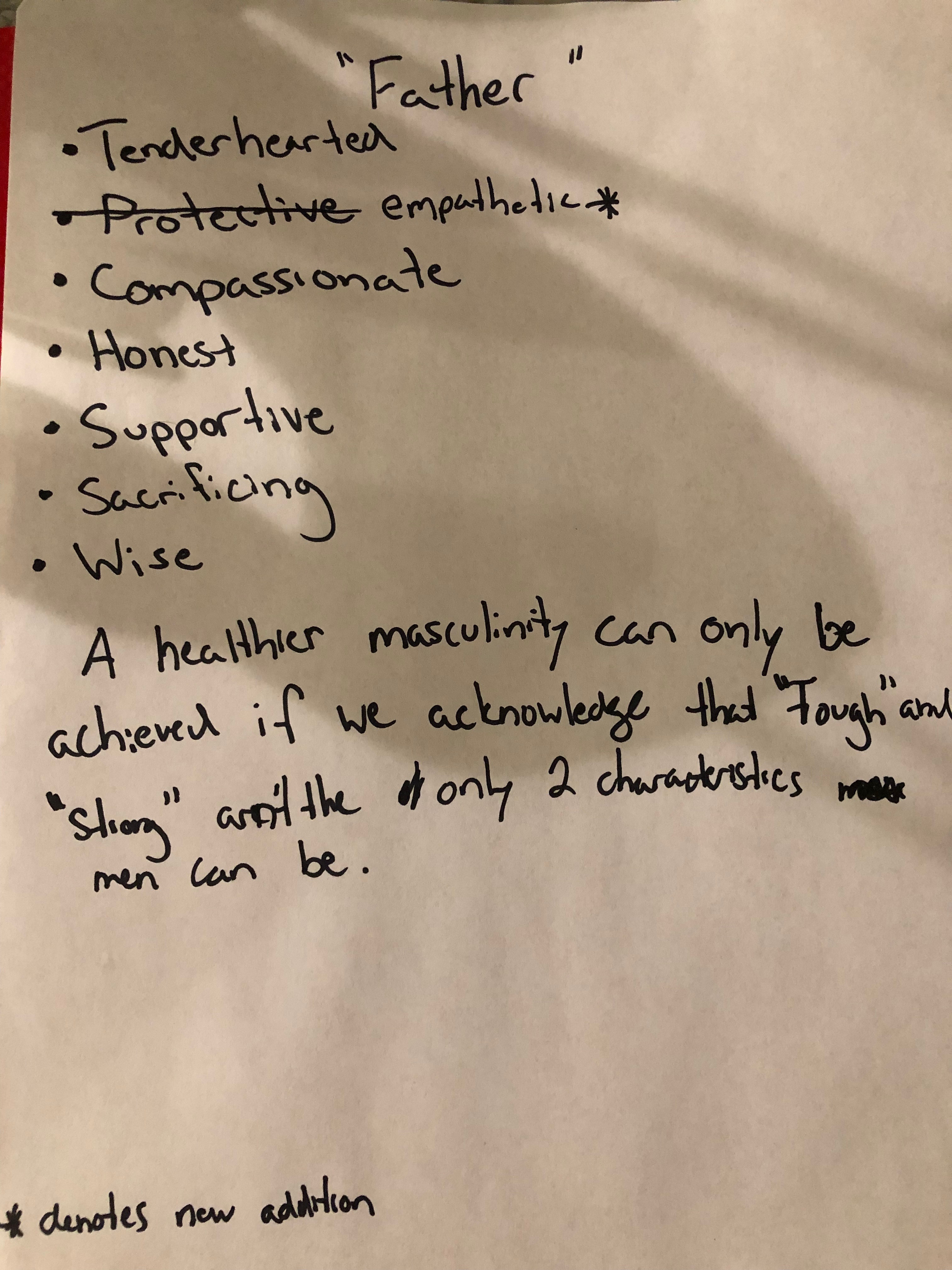
As part of a service-learning portion of an Intro to Sociology class, students were asked to take a piece of construction paper or plain white paper and mark in bold words a minimum of 5 words that best describe “mother” and “father”. We have been complicating those basic notions ever since.

Thinking about the authors we are studying assert about biology and gender, coupled with recent medical and policy developments, motherhood is more complicated than ever! The students were invited to revisit their original posters and articulate some of the information that has influenced their perspective in recent weeks. Some of their notes are below:

Words Added:

–       Gender Neutral:

·      The readings from this week highlighted the problems associated with gendered parenting

·       Mothers struggle with work because of the perception that they are obligated to care for their home and children

·       Men do not feel obligated to do any parenting work but feel an overwhelming obligation to provide economically for their families

·      Both genders are equally capable of parenting in the form of motherhood and fatherhood

·      everyone including children would be better off if parental duties were split equally

·      All other words on the poster represent things my mother, grandparents, and stepfather did and that I wish my father had participated in

·      Not parenting is a personal choice not a gendered choice

–       Parent:

·      Added for reasons listed above

·      Parent should imply the same duties regardless of the parent’s gender

       Present:

·      Being present is an essential part of parenthood that I did not think about until I watched “Glen Henry got his Superpowers Through Fatherhood”

–       Care:

·      “Mothering is most likely done by a female due to our society’s definition of the word ‘mother.’ The action of mothering however is simply caring for another.” [Castaneda and Oware]

–       Guide

–       Educate

·      Guide and educate were both terms I did not think to put until I though in the context of parenthood rather than motherhood

·      Gendered expectations affect us all and are very pervasive

Assertion Statement:

Replace motherhood and fatherhood with parenthood

Father
• Tenderhearted
• Empathetic
• Compassionate
• Honest
• Supportive
• Sacrificing
• Wise
“A healthier masculinity can only be achieved if we acknowledge that “Tough” and “Strong” aren’t the only 2 characteristics men can be.”

Categories
Conferences Featured Feminism gender History Internships manhattan college motherhood Sociology

Women’s History Month at Manhattan College

March is Women’s History Month! Find out more about The American Women’s History Initiative, which aims to “amplify women’s voices to honor the past, inform the present and inspire the future.” (Smithsonian Institution: Discover more online here). It seems we are all working towards the same goals.

Here at the MOM Pop Up, at Manhattan College in the Bronx, we have installed an exhibit in the lobby of the O’Malley Library. The exhibit is in collaboration with the LWGRC promoting Women’s Week, April 1-6th on campus. We are pleased to highlight just a few of the amazing American women who have helped pave the way for the rights, liberties, educational content, and social justice initiatives still relevant in our society today.

The installation will be onsite through April 4th and was coordinated through the Museum of Motherhood internship program. Please meet our newest intern Hannah Rome (in her own words).

Hannah Rome, Manhattan College Internship with the MOM Pop Up

My name is Hannah Rome and I was born in Northampton Massachusetts. I am the daughter of two wonderful mothers and the sister of two amazing sisters. Being from a small town in western Massachusetts, I had always to experience what it was like living in a big city. That is one of the reasons why I decided to attend Manhattan College

Right now, I am a current senior at Manhattan College majoring in Urban Studies and minoring in Sociology and Spanish. I decided to major in Urban Studies because of my interest in cities and people. I became a sociology minor because of the interesting course list offered at my college. Finally, I pursued a Spanish minor so that I could study abroad in Spain during the Spring semester of my junior year.

During my past four years as a student at Manhattan College, I have earned membership into two honors societies. First, I am a member of Epsilon Sigma Pi which is considered to be the highest scholastic honor that can be earned by a Manhattan College student. Second, I am one of the very first two inductees into Upsilon Sigma which is the Urban Studies honors society.

Alongside my academics, I have worked as a student coordinator at the Manhattan College Multicultural Center since my sophomore year of college. I coordinate a number of events such as HerStory, which is a panel discussion composed of women of color in the arts. I also coordinate a week-long leadership summit for undergraduate students to learn about New York City governance.

About Internships with M.O.M.: Each year the Museum of Motherhood (MOM) welcomes interns from a variety of disciplines. Each internship seeks to balance individual goals and needs with those of the museums’. Study labs, online courses, individual projects, visual displays, research, and guest docent opportunities are just a few of the ways MOM has worked with university and graduate students since 2011. Onsite and remote internships are available for the academic year. Write Director, M. Joy Rose: Museum of Motherhood; online, the MOM Pop-Up at Manhattan College in partnership with the LWGRC, and the MOM Art Annex 538 28th St. N. St. Petersburg: info@mommuseum.org, or to find out more about internships, follow this link.

Also, please see the latest media content featured in the Quadrangle Paper about bringing Mother Studies to the Manhattan College Campus with Professor Martha Joy Rose and the Sociology Department. Click on the photo to read the full story:

Categories
Art Conferences Feminism Literature motherhood hall of fame

This Year For Mothers’ Day – Buy a Book, Attend a Conference or Gallery, Share Knowledge

Mothers’ Day Week 2016

2016 INDUCTIONS to the Motherhood Hall of Fame; Honor the Call of the Midwife – Join us!

Thursday, May 5 – Motherhood Hall of Fame; Columbia Teacher’s College 7:30-9PM (Free). 525 West 120th Street Milbank Chapel, NYC.

Join us for drinks before at 7PM. RSVP Pleasehttp://motherhoodfoundation.wpcomstaging.com/motherhood-hall-of-fame/

Performances, story-telling, and induction ceremony with co-sponsors:

CONGRATULATIONS TO OUR HONOREES

Ruth Lubic (ED.D. ‘79, M.A. ‘61, B.S. ‘59)

Kimm Sun, is a Certified Nurse Midwife, Nurse Practitioner

MHOF_Header_2016

12th Annual M.O.M. Academic Conference

THEORIZING MOTHERHOOD IN THE ACADEMY

***M.O.M. Conference Panelists and Presenters – See Schedule. Each time slot is 20 minutes (unless I have written to tell you differently)***

Friday, May 6th MORNING OPENING KEYNOTE: Laura Tropp specializes in media and politics and representations of pregnancy, motherhood, and families in popular culture.

Saturday, May 7th MORNING OPENING KEYNOTE: Kimberly Seals Allers whose 5th book The Big Let Down will be published this summer. Kimberly is an award-winning journalist, author and a nationally recognized media commentator, speaker, consultant and advocate for infant health.

MORE at M.O.M./ FULL SCHEDULE

FACILITIES

We will be meeting in the Alumni Room, which is in the lower portion of the library. Look for signs, or take the elevator from the O’Malley Library.

TECH SUPPORT

There is a power point projector, computer, speaker, and screen onsite. Bring your laptop or a zip drive, or post your material in the cloud and you will be able to present using the equipment at our location. There is some limited space for brochures, art, and books as well. Feel free to share your passions.

BAGEL & COFFEE BREAKFAST WILL BE PROVIDED EACH DAY

SOCIAL MEDIA 

Do you have a twitter handle or a Facebook page? Let’s connect!!

  1. @MOMmuseum
  2. https://www.facebook.com/MOMmuseum/

CONFERENCE LOCATION

May 6-7 MOM Conference at Manhattan College, 4513 Manhattan College Parkway, Bronx, NY 10471 (Schedule TBD) – We will updating the schedule in the next few weeks.

TRANSPORTATION

New York City has two major airports: JFK and LaGuardia.

Public transportation is available from both via train, and cab.

The train from JFK is rather straightforward and costs about $7.50. I would encourage you not to be fearful about taking this option if budget is a concern. There are people at the airport who can direct you, and I’ve done this many times. Here is a link to the NYC Subway Map: http://web.mta.info/nyct/maps/subwaymap.pdf

PANELS, CULTURE, and SPECIAL GATHERINGS

New York City is an amazing place. Surely you will want to do a little exploring. We also plan on organizing a few special panels, roundtable discussions, and speakers for you, but will make sure there is time in the evenings to step out, either with conference goers or on your own.

GETTING AROUND

Here is a subway map of Manhattan.

FYI, the subway that best serves Manhattan College is the #1 or #6 train on the West SideLink to more info and directions to MC.

Please do not hesitate to contact me with any questions. We will continue to update the Conference tab.

  • ALSO PLEASE SEE – DEMETER PRESS – NEW RELEASE – NEW MATERNALISMSORDER NOW
  • New_Maternalisms