MoM has acquired the Mother Tree for our permanent collection! Thanks to each of you who donated through our GoFundMe, our website, or by private contribution. Thanks too, artist Helen Hiebert, artist and creator for trusting us and for additional support. Thanks to all of you we have succeeded in achieving this wonderful milestone.
This purchase represents the culmination of two years of fundraising for our permanent collection and we couldn’t be more pleased to share this success with each of you. If you have been fortunate to have seen the Mother Tree at the MoM Art Annex or one of her other previous exhibitions spaces, lit up and beaming, then you join an exclusive group who have indeed been fortunate. Moving forward we look forward to future large scale exhibition spaces where we can share her for public display.
May has been an incredible month for forging new connections, completing projects, and travel. For those of you who have been keeping up with travel blog reports from founding director, Martha Joy Rose, travels to the Goddess temples of Malta have been transformational indeed. You can read more about the Goddess’s of Malta at our founder’s blog.
Throughout June, July, and August, operations will continue at the MoM Art Annex though outreach activities are paused. Our team will be busy strategizing a year’s worth of exhibits for our 2023-24 season which commences in September. During the summer, internships, grant writing, renovations, and curatorial activities will be in full swing.
Finally, we want to share news from our recent experience at the Modern Herbal Apothecary in Tampa for a ‘Closing the Bones Ceremony’. Lyani Powers, doula and owner of MHA presented at this year’s annual academic MoM Conference on ‘Maternal Landscapes’. This ritualistic ceremony can be traced to South America, Africa, and Asia, yet here in American this ritual is not common. Founder Joy Rose was graciously invited to Lyani’s studio post-conference.
During the conference,Lyani shared that she performed ‘Closing the Bones’ on her mother-in-law so it seemed the ceremony could work on new mothers as well as older mothers. Here at MoM we recognize the ways in which many women continue symbolically, and in real life, remain attached to grief, trauma, and even may stay stuck emotionally or become over-involved in their adult children’s lives. Could this be a way to honor those sacred bonds while allowing space for closure and release? We were hoping so.
Nestled into a residential neighborhood Lyani’s gorgeous space is stocked with teas, herbs, and scents that are both delicious and healing. The ceremony itself involved sage, touch, a holding of the body and swaying gently while being gently cradled. This was followed by a tight body- wrapping, a rest, and it concluded with a ceremonial tea and washing of the feet. There were low mutterings, incantations, and prayers for releasing old patterns and welcoming new energy and new ways of being.
This was all a marvelous closure to our founder’s extended trip to visit the Goddess Temples of Malta. The divine feminine has been with us and the world for at least five-thousand years BC. How do those threads get lost? How do the rituals that sustain us disappear? We must weave our way back in time together to activate the symbolic strength of women as respected and glorious members of society.
The Museum of Motherhood’s first online exhibition was in 2010. The launch featured a Sacred Feminine exhibit created Polly Wood online. Now, thirteen years later in 2023, Batya Weinbaum began work on the Goddess mural at the MOM Art Annex for her ‘Artist in Residency’ project. There is a lot of herstory in this world to be mapped – indeed, there is a link to all our shared legacies and experiences. We encourage you to do some research on ‘Closing of the Bones’ rituals. There is much to learn and much to celebrate if we can stay strong in our bonds to each other and continue to find ways to collaborate. Find our more at ModernHerbalApothocary.com or search ceremonies online. And, please, whatever you do, make sure to stay strong. You are beautiful!
Modern Herbal Apothecary
Herbal Tea Time
Delicious
The wrapping prep
Sage and Conversation
Lyani Leads
The Bone Closing Ceremony
Lyani Powers, Doula and Owner MHA
Flower Foot Bath
Mushroom Walls
The Closing of the Bones Ceremony brought a SONG to mind and is summed up well here:
I can’t really explain it I haven’t got the words It’s a feeling that you can’t control I suppose its like forgetting Losing who you are And at the same time Something makes you whole Its like that there’s a music Playing in your ear And I’m listening, and I’m listening And then I disappear (Lyrics from the song Electric- Billy Elliot, the musical )
SLQS is a Franco-Vietnamese artist living in East London. Her work is interdisciplinary and questions the politics of space and who is excluded from it. SLQS makes and holds space as a woman, a person of mixed heritage, a foreigner, a mother and an artist. She invites her audience to decolonise spatial orders from imperialist, sexist and racist structures. SLQS has presented work at Totally Thames, Spitalfields Music, Rich Mix, Procreate Project, the Live Art Development Agency, the Royal College of Art, the Brunel Museum, the Migration Museum and the Attenborough Art Centre. She is a board member of the Creative Think Tank for UK New Artists.
The HBAC Performance Manifesto was written from my personal experience of being pregnant and not given access to a home birth or the birthing centre. Having previously had a caesarean, I was labelled ‘high risk’ and was not being heard.
On 4th and 5th November 2018, over 25 hours, I performed the act of giving birth at home with the support of two independent midwives. The birth was documented as an act of everyday life in the domestic space, with cameras set up in my kitchen, my bedroom and my living room. The Manifesto declares my views on birth as an every day performance and Home Birth After Cesarean (HBAC) as being a safe birth
option. It was published by the Association for Improvements in the Maternity Services (AIMS) in 2020.
Independent midwifery supports choices for women by providing evidence based information and continuity of care to women. Since 2020, due to their insurance product being annulled, their home birth practice is now prohibited, threatening an ancestral profession and restricting women’s birth rights. A group of independent midwives are taking action and fundraising to set up their own insurance product owned by women, with the long term goal to set up a hardship fund. You can support their campaign here: Childbirth Choices Matters.
HBAC PERFORMANCE MANIFESTO
To the medicalised institutions, their medical staff and the health governmental bodies
ARE YOU LISTENING TO ME?
NO I am not high risk
NO I will not go to the labour ward
NO I will not be immobilised by continuous monitoring NO I will not labour under time pressure
NO I will not listen to you
NO I will not be given a trial of labour
I WILL LABOUR!
Giving birth is an ancestral ritual which has been performed at home by women for centuries. An act which has ensured the survival of the human species.
Women and daughters have witnessed the act of giving birth for millennia. Women can perform the art of giving birth and every performance will be unique.
Giving birth is a creative act.
The ultimate act of transformation.
A HBAC (Home Birth After Cesarean) is a political act attempting to shift the power from an obstetrically-led medical institution to a woman-centred care approach.
Labour is a durational performance: starting spontaneously with an unexpected duration.
A HABC gives time to the performance of labour. There is no failure to progress, only failure to wait! Patience and respect for the process is practiced.
A HBAC requires participants to support the performer throughout the act of birth. Midwives, partners, family members, friends will be chosen in advance by the performer to participate in the event.
A HBAC enables the performer to control her birth. She is informed and capable of making the right decisions for herself and her baby. She rejects the politics of fear and failure institutionalised by hospital birth.
A HBAC should be available to all women without resistance. All women are eligible for care and should be in control of their choices without judgement.
I AM STRONG
I AM CAPABLE
I TRUST MY BODY I TRUST MY BABY
The performance of HBAC is not a medicalised event. It is a holistic act celebrating life itself. HBAC is performed without the traditional medical props.
NO Forceps NO Ventouse NO CTG
NO Cannulas
NO Augmentation Drugs
NO Amniotomy
NO Epidural
The performance of HBAC challenges the current medical hierarchy of birth. Verticality is replaced by horizontality.
The performance of HBAC reframes birth as an event in a woman’s life in her domestic environment. There is no drama.
Giving birth is a woman’s right of passage into motherhood. A physical and mental journey leading to an act of transformation. Such a journey requires preparation and planning, knowing that unforeseen circumstances can change the course of actions.
A birth plan is a manifesto of personal preferences.
In the performance of HBAC, hospitals and obstetrics interventions are for emergencies only. Giving birth is an innate performance. A primal aptitude buried deep inside every woman.
The performance of HBAC redefines risk. Risk is not measured as a possible scar rupture but as avoiding another assisted birth and future mental trauma associated to this experience.
The performance of HBAC promotes independence. INDEPENDENCE in the choices the performer makes about her birth. INDEPENDENCE from hospital’s policies
INDEPENDENCE from unnecessary medical intervention.
The performance of HBAC respects the culture of birth and the art of midwifery. The performance of HBAC is an act of activism.
Written by Sarah Le Quang Sang, October 2018,
In Flat 55 Maitland House, Bishops Way, London, E2 9HT
(Violet is a remote student intern, crafting literature and book reviews for MOM. In this creative piece, she envisions giving birth for new mother Lelani who must figure things out on her own)
Lelani felt pressure on her pelvis one day. She needed to pee really badly and felt her breath go short. She saw clumps of mucus in the toilet. Suddenly, she realized: her water was breaking. The big moment had arrived. She never thought she would do it all alone, but here she was.
Feeling an ungodly pain in her lower back and abdomen, she was more terrified than she’d ever been in her life. Somehow, despite her panic, she still remembered the list: photo ID, health insurance card, outfit for the next day, outfit for the baby. She called a cab to the hospital. It felt like the longest she’d ever waited for anything in her life, even though it actually couldn’t have been more than 20 minutes.
The driver stepped on the gas. “Sir, I think there’s a faster way you can go,” she sighed, irritated.
“No, ma’am, there’s no faster way,” he said.
Walking into the hospital, she saw a pile of paperwork she had to fill out. Why why why?
Once the nurse examined her and confirmed she was really about to give birth, she changed into a hospital gown.
“Are you doing an epidural or aiming for a natural birth?” The nurse asked.
“What do you think?”
“Epidural?”
“You bet.”
The nurse moved her to the bed. She wondered where her obstetrician was, but was too tense to ask.
Then, she began to feel the intense pain of contractions. She waited for them to end. They didn’t end. They started to get worse. The nurse started pushing her stomach. There was nothing but pain and pushing for hours.
Then, suddenly she heard a baby cry. It felt like magic washing over her.
“Here you go!” The nurse handed over her baby. Holding it in her arms, she wasn’t sure how she felt. Fear? Anticipation?
“When can I go?” She asked.
“A day or two,” the nurse said.
She fell back asleep. The next day was a blur of being handed food and liquids.
Then, she bundled the baby up and got a cab back to her apartment. Ready to enter the new world, all alone-with a new little stranger.
Our Bodies, Ourselves was written by The Boston Women’s Health Collective in 1970, with the goal of promoting women and girl’s health, reproductive rights, and sexuality. The knowledge presented was radical for its day, illuminating topics as varied as masturbation and abortion.
To quote the Los Angeles Times, “Forty years ago, a copy of “OBOS” on the shelf signified you were a certain type of woman — curious, and unashamed of it. In control. You were not the high school junior who was clueless about sex and pregnancy and missed six months of classes due to “mono.”[1]
Three years after Our Bodies was published, abortion in America became legal with the passing of Roe Vs Wade.[2] Sex education programs in classrooms had been gaining in traction in schools since the 1960s.[3] However, controversy about girl’s bodies and who controls them has continued to be a topic of debate and public discourse.
Even in 2020, there is still growing pressure for women to get plastic surgery and sexual images shown on media pressure teenagers to engage in certain behaviors. While there have been many systemic changes, teenage girls’ vulnerability to STDs, ongoing pressure to have sex at a young age, and unrealistic beauty standards haven’t changed enough. Society continues to evolve, but when it comes to recognizing individual’s personal choices there is still room to be more inclusive.
Early versions of Our Bodies, Ouselves did not include information about transgender identities, environmental concerns, or mental health advice. However, the writers have since expanded their knowledge. In 2020, Our Bodies, Ourselves launched a website. Today, they give well-researched advice, on health, sexuality, and wellness for women, girls and also transgender people.
Throughout the years, The Boston Women’s Collective has inspired health care policies, research on women’s health, feminist activism, feminist studies, health care, and health activism. Prior to the publication of this seminal piece of literature, in many parts of the world, sexuality as well as reproductive rights had many negative associations.[4]
I have grown up in an era of increased knowledge. Gone are the early-day doctors who focused on women’s reproductive value, and used “hysteria” as a diagnosis, which minimized women’s emotional wellbeing and invalidated women’s experiences.[5] My grandmother nearly died from a botched illegal abortion in the early 60s. The original copy of Our Bodies, Ourselves in my bookcase was inherited from her. Because of the work of the Boston Women’s Collective, I am privileged to enjoy a more positive outlook than many women from my grandmother’s age.
Access to the internet in 2021 connects us at unprecedented levels. One recent novel titled, Conversations Between Friends published in 2017, by Sally Rooney, discusses the topic of endometriosis. The main character gets diagnosed at 21 years old. The disease is often undiagnosed and rarely mentioned in the media, even though it’s been known to have serious effects on mental health, and even on education. Endometriosis is addressed on the new Our Bodies Ourselves website.[6]
Despite a prolific and sometimes superficial “wellness culture” that includes dubiously helpful information, there is a forty-year-plus history of Our Bodies Ourselves which gives people verified information that is dedicated to addressing topics as wide-ranging as motherhood, health, reproductive-control, and emotional well-being. That is a good thing!
urselves– and how one book can change your entire life.” Laura lambert. Brightly. Online. Accessed January 9, 2021.
[5] The female problem: how male bias In medical trials ruined women’s health.” Gabrielle Jackson. The guardian. November 13, 2019. Online. Accessed January 8, 2021.
Meet our newest intern, English major Violet Phillips from Mills College, Oakland, CA. Read more about Violet on our Internship page. We look forward to her ongoing reports from the MOM Library, posted here throughout the next few months.
Ever since the beginning of summer, my roommates and I have committed to working out at least twice every week. On weekends, we push the living room tables aside, connect our laptop to the TV, and follow the home workout videos on YouTube. The initial dread of regularly drowning in sweat and enduring physical pain soon disperses and is replaced by the joy of engaging our muscles and building our stamina while occasionally laughing at each other’s random comments. I feel grateful that we are continuing this ritual despite the increasing workload we have as students with the semester underway. Exercising together has not only helped keep us active while cooped up at home but also gives us time to focus on ourselves: our bodies, our preferences, our limits. Here at MOM, I am hoping to reflect on some of the ways in which I mother myself as I continue to explore topics in my reproductive justice class with Holly Singh at USF. [My bio link for the museum internship program is here].
Yet, for many expecting mothers as well as mothers who have recently given birth, engaging in physical activity has become their “third shift”. A concept developed by Dworkin and Wachs (2004), the “third shift” refers to how mothers, besides their first working shift and second shift of tending to household matters and childcare, are also socially coerced into participating in fitness regimens in order to “erase physical evidence of motherhood” Mallox, DeLuca, and Bustad (2020). Through thematic analysis, the authors studied the causes and ways in which mothers engage in this cultural phenomenon. They determined five categories that identify mothers within this “third shift’, namely Marathon Moms, Family Fitness Focused Moms, Gym Goer Moms, Custom Coached Moms, and Internet Inspired Moms. The study notes how the media and consumer products have been tailored to pressure mothers to “regain control over their body” and examines the ways in which women’s bodies, post-birth, are conflated with “individual responsibility and moral fortitude”. Both studies also underline how socioeconomic status is entwined with these unrealistic expectations, as not all mothers are able to afford the resources needed to engage in the “third shift bodywork”.
Putting the findings into perspective, I cannot help but feel enraged by postpartum aesthetic ideals that are perpetuated by businesses to profit off of mothers’, and the ways in which they prevail. Rather than being able to prioritize individual well-being with potential health concerns, mothers are subjected to unnecessary and often impractical expectations of having a “good” body by society’s standards. Perhaps unknowingly, my friends and I are also influenced by societal expectations of how our bodies should look when we engage in our workouts as well as in our daily lives. In addition to that, the study prompted me to contemplate how physical activity is dictated by our socioeconomic status. My friends and I do not have the means to afford a personal trainer or special exercising equipment, but we at least have the luxury of space, time, and ability to engage in regular physical activity. This is a clear indication of the health disparities present in our society and yet, the shape of our body is still believed to be determined by how much control we have over ourselves and how responsible we are as individuals. As I enter the next workout session with my roommates, I will keep this in mind: as much as fitness should be promoted, it should never be a measure of one’s character.
Photo credit: Karolina Grabowska from Pexels
References
Maddox, C.B., DeLuca, J.R. and Bustad, J.J. (2020), Working a Third Shift: Physical Activity and Embodied Motherhood. Sociological Inquiry, 90(3) 603-624. https://doi.org/10.1111/soin.12297
Shari L. Dworkin, & Faye Linda Wachs. (2004). “Getting Your Body Back”: Postindustrial Fit Motherhood in Shape Fit Pregnancy Magazine. Gender and Society, 18(5), 610-624. http://www.jstor.org/stable/4149421
Can you imagine a scenario that would finally push you over the edge?
Or do you just keep telling yourself you can handle anything?
For people who care for others, hitting rock bottom is often an abstract principle. You do whatever it takes to keep on going. Because what’s the alternative? Really? People you love are counting on you. If you’re exhausted, you have to keep going. If you’re overwhelmed, you have to keep going. If your hands are shaking so badly that you break the plate you’re trying to clean, and then you burst into tears because you’ve failed to clean that plate, and then can’t stop crying, and then go numb and sometime later realize you’re still sitting on the kitchen floor…you stand up and finish the washing up, hands wrinkling in the cold water. Because you have to keep going.
I care for my mother. I need a break, I tell her. She doesn’t understand why; I explain that I’m struggling with my mental health, that I’m tired and stressed all the time. That I have been for a long time and it’s taking a serious toll.
She suggests I try chilling out.
I leave the room and scream into my pillow.
A few days later she hangs up the phone and beams at me. Your sister has agreed to help out while she’s visiting! Anger wells up inside me, hot and dry. Why on earth is it up to her? My sister knows the least about this situation, has no knowledge of how hard it is. Why on earth is she the one to decide if I get to have a break or not? Why does she get to choose when she takes care of our mum, but I don’t?
I know this is supposed to be a good thing. But panic overwhelms me. I have been resenting my caregiving but I can’t let it go. I have held it too tightly for too long. It’s who I am. Can I trust my sister to do it right? Is she going to mess up my carefully organized systems, making more work for me in the long run?
Or worse. Is she going to tell me that this is all easy, that I have nothing to worry about really, that my stress and frustration and despair and isolation are not valid emotions, but rather a symptom of my weakness and failure?
Why is accepting help so difficult?
Why can’t we put down this toxic burden of control? I want to relinquish this weight of responsibility so badly. I want to be able to move freely within my life. To do things that are only about me. I know that I can be a better person if I manage to do this and that it will mean I take better care of my mum; as people are so fond of telling me.
You can’t pour from an empty cup.
But people are not cups. Filling yourself up again is difficult.
And this is what I think of as the heart of the problem: The stress is the only thing that enables you to get stuff done. The most sustainable option is to remain stressed, like a plane using less fuel to cruise than to land, refuel, and take off again.
Stress gets you out of bed in the morning, gets the kitchen cleaned. I can’t relax while there are the bins to take out; I can’t sleep properly if I’m also listening out for mum’s call for help.
To let go of my stress is to relinquish my responsibility; and that is an impossibility as long as I have people relying on me.
If you look back on the history of birth in the U.S., 95% of infants were born at home with midwives. Promptly after birth, the child was placed on the mothers’ breast to nurse. Today, many women seem to doubt their ability to give birth naturally and breastfeed. Often society does little to support them.
Many women desire to breastfeed and though the rates have slowly been rising research shows there is still a decrease in breastfeeding rates from birth to one-year. A quick google search will show you why there is a decrease. What is not listed amidst the CDC research is how women have been taught to not trust their bodies.
In America, it is more common (and comfortable) to see women advertised in lingerie and skimpy clothing. At the same time, a woman nursing in public can publicly shamed or experience feelings of discomfort, or be judged critically. Nursing mothers are still evicted from public spaces, restaurants, and they encounter rude comments when strangers express they do not want their child(ren) exposed to breastfeeding. Although breastfeeding is what our bodies are designed to do, it can be awkward and has been referred to as something to be socially discreet about.
As a mother of three boys, I would rather have them grow up knowing breasts have a purpose. Women’s bodies are uniquely formed to feed babies and also to comfort them. Additionally, nursing a newborn helps with psychological development (and so many more other beneficial things).
In some communities, mothers have access to breastfeeding help through groups like La Leche, as well as breastfeeding cafes and mother support groups. Still, some mothers struggle. It could be that many mothers continue to get false information from health care professionals who are not educated about lactation, and though health care professionals mean well, they sometimes insinuate that mothers should not trust their bodies.
All breastfeeding mothers should have access to local references from lactation professionals and be free of cruelty and judgment. If an advisor is not available, then there are other ways to connect to professional consultants including email, phone, and video chat. Unfortunately, these options are not always promoted. Many health care professionals unintentionally perpetuate myths about breastfeeding. For example, I have heard of women being told that breastfeeding can hurt; NO! Breastfeeding should not hurt! If it does, then it is a signal that something may be wrong and the nursing mother should seek help from an IBCLC. There are so many myths that continue to be perpetuated. Here are a few listed online courtesy of the United Nations International Children’s Emergency Fund, UNICEF [LINK].
Even with available resources, some mothers of young children struggle just getting out of the house. They’re tired, overwhelmed, and are dealing with a mixed bag of emotions. If they have a messy house on top of that, they may not want to entertain visitors. Believe me, no one coming to support or assist a mother with nursing is spending their energy judging a messy home. (My own kitchen has been not been cleaned since I had my first son 8 years ago and yet, I continued to have more children)!
In this shared graph from Katie Hinde, an Associate Professor of Evolutionary Biology and Senior Sustainability Scientist at Arizona State University, and a researcher of lactation, she shares on this brief clip on Ted Talks what little we know about breastmilk compared to other subjects.
She shares this powerful message, “Many mothers do not reach their breastfeeding goals, that is not their failure, it’s ours.”
Do nursing mothers have rights? Yes, they do. But in 2019 some mothers still struggle with being told they can not nurse in public. As recently as this summer, a woman in Texas was told she could not nurse her baby at the public pool. Even though this mother knew hew rights, this issue escalated quickly and police were called to the scene. A breastfeeding mother has rights for a reason. These rights should not only be known by mothers but by public servants as well. Government employees as well as other facilities that say they support breastfeeding mothers need to be required to read and understand breastfeeding rights for customers, as well as their employees. This can vary from state to state. Mothers nursing in public helps to expose the general public to an infant’s needs as well as the very natural act of maternal nursing.
Even though some people in the general public may be hurtful, many other breastfeeding advocates will support you. We are mothers, we have the right to feed our babies as we choose, and we will not be silenced for choosing to breastfeed whenever and wherever our child is hungry outside the home.
According to the CDC among the infants born in the United States, 83.8% start to breastfeed and by 12 months the amount of breastfed babies is down to 36.2%.
“A more recent study that used costs adjusted to 2007 dollars and evaluated costs associated with additional illnesses and diseases (sudden infant death syndrome, hospitalization for lower respiratory tract infection in infancy, atopic dermatitis, childhood leukemia, childhood obesity, childhood asthma, and type 1 diabetes mellitus) found that if 90 percent of U.S. families followed guidelines to breastfeed exclusively for six months, the United States would save $13 billion annually from reduced direct medical and indirect costs and the cost of premature death. If 80 percent of U.S. families complied, $10.5 billion per year would be saved. (Economic Effects).”
There are a variety of reasons mothers stop breastfeeding by 6 months including, concerns of milk supply, baby’s weight, issues with latching, unsupportive work policies, lack of prenatal leave, cultural norms, and lack of family support. So, what is a mother to do if she desires to breastfeed? In my previous post I gave an overview of the importance of seeking an International Board Certified Lactation Consultant (IBCLC); because they have received thorough lactation education. IBCLCs can be found in many areas, but many of them are employed in Hospitals, WIC offices, and Private Practice.
In Hospitals where an IBCLC or a Certified Lactation Counselor (CLC) are present, a visit to assist mom with a correct latch with baby, as well as address any breastfeeding concerns, is done during the mothers’ hospital stay. As the baby grows each week after his/her birth the breastfeeding experience can continue to change; bringing new questions on how to know if you’re doing this whole breastfeeding thing correctly! Most Hospitals will assist you during the entire course of your breastfeeding journey. However, some mothers forget that they can receive help from the hospitals IBCLC or CLC staff beyond the newborn stage.
Anna Kell Artwork Nursing_Install; MOM museum online exhibit
WIC participants benefit greatly from having the ability to contact breastfeeding support during pregnancy, after birth and up to the child turning 5. Many WIC offices have IBCLC, CLCs and Breastfeeding Peer Specialists; these specialists are experienced breastfeeding mothers that have undergone some training to assist mothers. At WIC, a parent could work with these available sources with the continued visits required at WIC for nutritional help. Although WIC is income-based and not available to every parent. As well as the fact, that some mothers report it is easier to access baby formula through WIC than breastfeeding help. (Source- Breastfeeding in the Public Arena Pg. 153 MJR).
Private Practice IBCLCs may face more of a challenge with assisting clients due to a conflicting relationship with insurance companies. Insurance providers have a variety of policy plans available to their customers. It may be in your best interest to call your insurance company during your pregnancy to see what is covered with breastfeeding supplies, (like a breast pump) or lactation visits, what documentation will be required, and the time frame you may face while waiting for coverage, if you have any, with your insurance. The information provided by your insurance company based on your plan, which can easily differ from other individuals’ plans, may help give you a better understanding of what you need to prepare for. Many insurance plans require an “in-network” provider, this means the lactation consultant has an agreement with the health plan to provide services. For some private practices, this may be easier said than done. An e-mail survey of U.S. IBCLCs in March of 2011 conclusion recorded that, “IBCLCs provide key care to a vulnerable population. However, we found that these services are not consistently reimbursed. IBCLCs poorly communicate their health care activities to insurance providers, but insurance providers also inconsistently recognize and reimburse IBCLC care.”
I recently interviewed IBCLC Heather Gansky, her practice is The Tree of Life Lactation located in South Carolina. She has also been a La Leche League Leader since August of 2016.
Question: Have you come across mothers experiencing difficulties nursing their baby and insurance companies denying coverage for Private Practice appointments with a Lactation Specialist?
Heather: Yes there are a ton of denials from insurance companies. Most moms do have to resubmit with different codes because each insurance seems to have it own way they like to do things.
Question: If a mother does not qualify for WIC, and is unable to attend La Leche League meetings, where do you suggest she go for assistance?
Heather: If I run into a parent who doesn’t have WIC or can not come to meetings I will either refer her to an IBCLC in our area, myself being one of them on a list about 3 others. Also, there are hospitals that have support groups, and some areas have baby cafés that anyone can drop into for help they need. It really depends on the situation and if she needs one on one help or peer to peer support.
Question: From your experience, how often do you think mothers seek breastfeeding help? Where is the best source for them to turn to address breastfeeding concerns? (Newborn stage, 3 months, 6 months, 12 months, 2 +years.)
Heather: I find mothers sometimes wait too long to seek help for breastfeeding issues. It’s only until they are able to throw in the towel due to pain or poor weight gain in their baby that they actually seek help, and sometimes that’s much too late. Generally, we see babies in the newborn stage-1 month; then again around 3 months when babies really need to be good and suckling and using their tongues and mouths correctly to actively get milk out. If we didn’t see a baby in the early days but see them in the 3-month range it is typically due to mouth abnormalities which went undiagnosed either due to moms oversupply/ overactive letdown and the baby was riding the huge letdown portion of the feeding session.
Question: Do you think insurance companies are helpful to mothers seeking breastfeeding help? Or does the process of waiting for approval leave moms in a position of crisis where they turn to formula feeding, even though breastfeeding was their first choice in how they wanted their baby fed?
Heather: Some insurance companies have staff on hand to help with common issues/questions over the phone. There are some IBCLCs that are in-network for some insurance companies, but most work in offices and don’t do home visits. Most parents need help right away and aren’t waiting for insurance approval. In the case where parents don’t have money to pay for a consultation out of pocket they sometimes can go back to the hospital they delivered at however they are put back in the same situation with the same providers who are time-constrained and didn’t help them, to begin with. Many parents just don’t want to go back to those providers.
Question: Do you think that if health insurance companies were more supportive on coverage for visits with a lactation specialist that there could be a possible increase in breastfeeding rates?
Heather: Oh I’m sure of it. Most families are living paycheck to paycheck. They can’t afford a lactation visit… especially when one or both parents are out of work for the birth of the baby.
Question: Do you think families would benefit from visiting with an IBCLC before baby is born?
Heather:Yes. Education before birth is one of the key factors in initiation as well as the duration of breastfeeding.
The cost of breastmilk itself can be free. However, breastfeeding may have some additional costs. A mother could get around not having a breast pump and could choose to hand express, but meeting with an IBCLC or other lactation specialists may be more beneficial in helping you reach your breastfeeding goals. A visit with a consultant may range in price from $100.00-$300.00 depending on your location, but this is still a very low cost compared to a months’ worth of formula which can cost up to $243.00 per month, or you can use this Formula cost calculator to determine costs. If you plan to breastfeed, and during pregnancy you read the books, attend the breastfeeding classes, you may still want to be prepared to visit with a lactation specialist after the birth of your baby. Requesting funds as a baby shower gift, holiday or birthday, to visit with a lactation consultant would be an amazing gift to receive if you feel you may need help with affording the cost to visit with a consultant. You may be lucky enough to even be reimbursed by your insurance company after these visits, but it is best to save up on your own for a visit to avoid a feeding crisis, then waiting for the insurance to get everything in order. Either way, if you want to breastfeed, that is your choice. Income and Insurance coverage should not be left to chance.
More on education:
Please see the Free Webinars offered through the United States Breastfeeding Committee. The next 11/20 Session: Building Relationships: a Key to the Rise of our Indigenous Breastfeeding Communities
will be presented by Amber Kapuamakamaeokalani Wong Granite, Breastfeeding Hawai’i Coalition.
O ke kahua ma mua ma hope ke kūkulu: First the foundation, then the structure can be built.
This Hawaiian proverb teaches us the importance of building relationships in order to ensure the rise of our people.
Whether we seek to influence fellow learners, patients, or customers, we must get to know them before we can ask them to make a change. Once we seek and understand where they come from, what is truly important to them, and then help them unpack their stories, the real work can truly begin. During this session, we will hear an oli, Nā ʻAumakua. This oli acknowledges our ancestors, our land, and our nation. It invites strength, knowledge, and power into our space. MOM founder and director, Martha Joy Rose has participated in these and found them educational and helpful. (See the certificate at the bottom of the page)
As a mother and La Leche League leader, I often hear stories from other mothers about their breastfeeding experience. The experiences they relay are often from their first few weeks after giving birth. Though every mother’s story is different, I have noticed an underlying issue many seem to face. I realize that many mothers, after leaving the hospital, are unsure of where to turn when they have difficulties with nursing.
The health care staff surrounding a mother during birth are extraordinary in their job. They care deeply about the well being of mommy and baby. But what happens when mom is about to nurse the baby and the newborn needs assistance? Each position of a health care provider during the mom’s transition from pregnancy to motherhood has an important role in assessing the overall health of the mother and the infant. Professionals are trained to prepare mothers for the birth process. However, when it comes to breastfeeding education, oftentimes things are left to chance. Why does this additional education matter? How do parents access information? These concerns usually surface once a mother is searching for help and she may receive a mix of confusing information; or sometimes, even though the mother is determined to breastfeed, she is given formula and told to use it to feed the baby.
Every breastfeeding experience is individualized and can be so very different. If breastfeeding is not working, a family can be forced to decide what is best for them and their child in the midst of a feeding crisis. There are many examples involving a new mother who is having nursing difficulties receiving conflicting information from a variety of well-intended sources. If her go-to people are the health-care providers she used for pregnancy and birth, and the information she needs to keep breastfeeding is not forthcoming, then she might not question the use of sample formula that was given to her upon her hospital release.
So, who has access to breastfeeding education? How much education is required? Why does it matter? Well, let’s start with OBGYNS and Midwives; I tried looking for an overall amount of hours in the breastfeeding education required during certification. I came across some articles that mentioned only a few hours of breastfeeding education were required. The basics are taught to assist the mother with the first latch. This education varies from state to state. Of course, as a patient, with breastfeeding-related questions, you can ask during your appointments with an OBGYN or Midwife, and they may direct you to a specialist in the field of lactation. After the birth of your baby, labor and delivery staff may also assist a mother with that first latch. Labor and delivery nurses are superheroes; however, they are not required to have any breastfeeding education when hired. Labor and delivery staff are encouraged to follow along certified lactation staff to gain more knowledge in helping mothers, and some hospitals provide basic breastfeeding education classes, twice a year to their employees, and also makes sure that staff watches the same breastfeeding videos they provide patients with.
If you notice your nurse is not able to address your needs with breastfeeding concerns, do not panic, they are doing their best to help you. You may also request a visit from a lactation consultant to get more in-depth information. Pediatricians, who see most of you and your baby, tend to get a lot of parents voicing breastfeeding concerns they also receive only a few hours of breastfeeding education. Again, they want what is best for your baby’s health, but it is your interest to find a lactation consultant to address potential nursing concerns.
A Certified Lactation Consultant has the most lactation education and a wealth of knowledge when it comes to breastfeeding. Getting help with breastfeeding, from a lactation consultant matters, since they have so many hours invested to become certified. From the International Board Certified Lactation Consultant (IBCLC) website, here is a list of 3 different pathways a person can take to become eligible to take the exam: “IBLCE provides 3 ways that candidates, health care professionals or non-health professionals, can obtain the required clinical practice in lactation and breastfeeding care:
Pathway 1 – Completing a minimum of 1000 hours of lactation specific clinical practice in an appropriate supervised setting within the 5 years immediately prior to examination application.
OR
Pathway 2 – Completing an accredited lactation academic program that includes at least 300 hours of directly supervised lactation specific clinical practice within the 5 years immediately prior to examination application.
OR
Pathway 3 – Completing an IBLCE-verified Pathway 3 Plan of at least 500 hours of directly supervised lactation specific clinical practice with an IBCLC as described in the Pathway 3 Plan Guide and obtained within the 5 years immediately prior to examination application.
Please note that personal experience breastfeeding your own children and experience helping family members and friends cannot be used to qualify for the IBCLC examination.” (1)
Another position in assisting a mother with breastfeeding is a Certified Lactation Counselor. This position allows one to receive an abundance of lactation education, but it is not as extensive as the IBCLC exam. To become a Certified Lactation Counselor, one must attend a 5-day course, more information on the curriculum is here: https://centerforbreastfeeding.org/wp-content/uploads/HCP_Spring_2020_Flyer.pdf
Other positions that include breastfeeding education and personal experience are Breastfeeding Peer Counselors and volunteering La Leche League Leaders, some areas also have support groups or local meetups for breastfeeding moms.
All the health care providers that assist a mother during pregnancy, birth and after birth want the best for mom and baby when it comes to health if you are not sure where to ask for help after having baby, speak up! A lot happens in a hospital setting after your birth, it is understandable to forget information, once you are home with baby, You can call the hospital you delivered at, a WIC office, insurance company, or see if a local moms group can help direct you towards a professional that may be able to assist you. Some websites such as this https://www.ilca.org/why-ibclc/falc may help you find a lactation consultant in your area.
Breastfeeding can be hard, but with the support of other mothers, and receiving assistance from a person who has had extensive education with lactation, there may be a better chance for you to reach your breastfeeding goals.
WANT MORE?
See one of MOM’s USF intern’s mosts on breastfeeding last semester with additional resources here.
Also, Kimberly Seals Allers, author of The Big Letdown which cites the economic and political influences of big business and breastfeeding in America, penned an OpEd citing multiple activists in the field including Museum of Motherhood founder, Martha Joy Rose in the Washington Post – Read it here.
This summer, extreme weather rocks America and pundits debate while August arrives all too quickly. Since July 1st, accounting majors, economics majors, and students of literature have been increasing their knowledge and vocabulary about important issues that affect us all by studying sociology. These students are hard at work exploring theoretical assertions about race, class, and gender in an online summer intensive Introduction to Sociology course, specifically framed around the Sociology of Family.
Using texts that explore gestation, birth, and caregiving, authors Barbara Katz Rothman, Phyllis Chesler, Patricia Hill Collins, and Keisha Goode (to name a few), explore women’s experiences, racial disparities, and gendered labor. This week, we read the latest media stories on wombs, trans-birth, uterus transplants, and self-identified men as mothers. We have all been scrambling for new definitions and fresh ways of thinking about gestation as well as parenting.
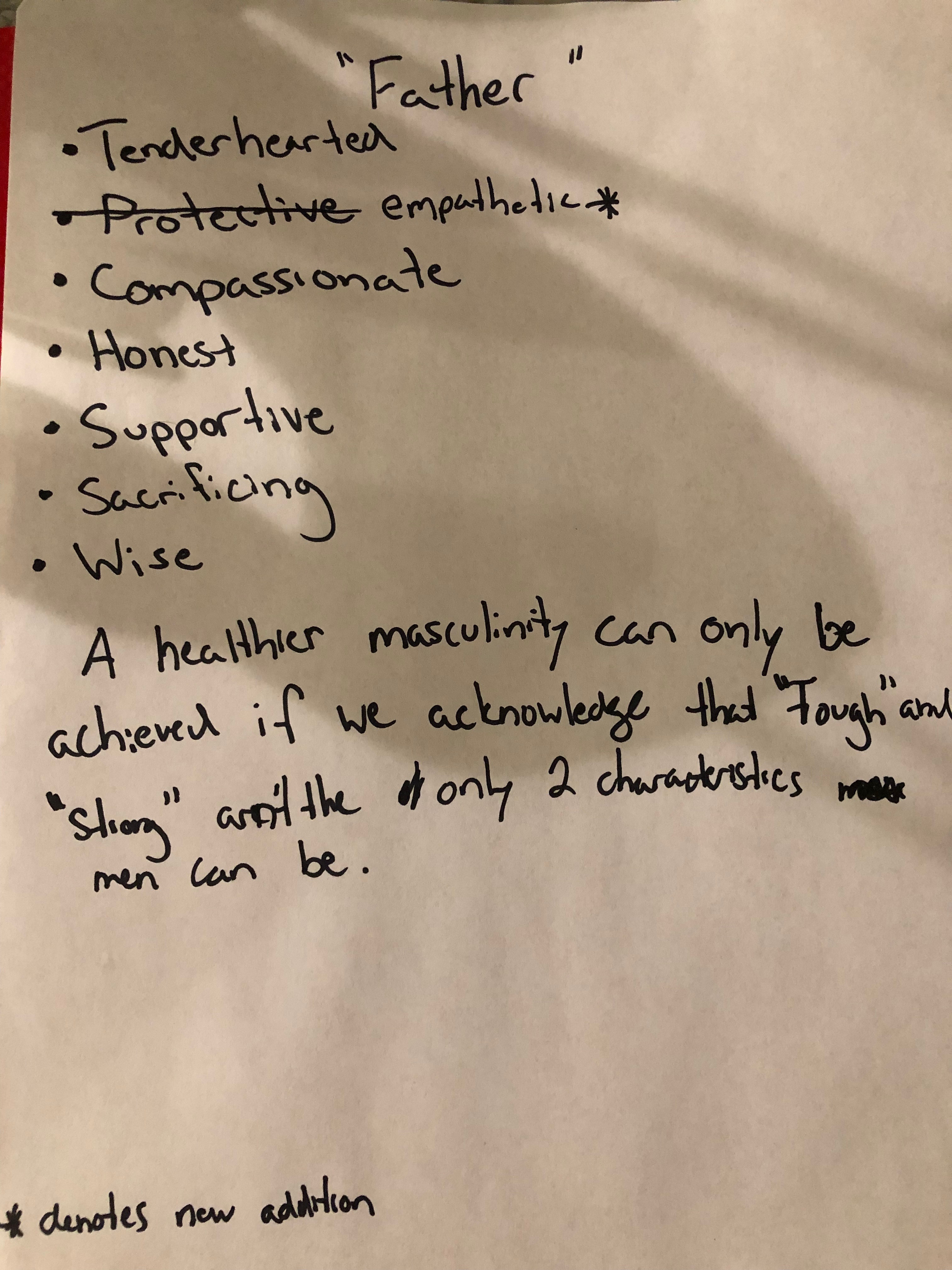
As part of a service-learning portion of an Intro to Sociology class, students were asked to take a piece of construction paper or plain white paper and mark in bold words a minimum of 5 words that best describe “mother” and “father”. We have been complicating those basic notions ever since.
Thinking about the authors we are studying assert about biology and gender, coupled with recent medical and policy developments, motherhood is more complicated than ever! The students were invited to revisit their original posters and articulate some of the information that has influenced their perspective in recent weeks. Some of their notes are below:
Words Added:
– Gender Neutral:
· The readings from this week highlighted the problems associated with gendered parenting
· Mothers struggle with work because of the perception that they are obligated to care for their home and children
· Men do not feel obligated to do any parenting work but feel an overwhelming obligation to provide economically for their families
· Both genders are equally capable of parenting in the form of motherhood and fatherhood
· everyone including children would be better off if parental duties were split equally
· All other words on the poster represent things my mother, grandparents, and stepfather did and that I wish my father had participated in
· Not parenting is a personal choice not a gendered choice
– Parent:
· Added for reasons listed above
· Parent should imply the same duties regardless of the parent’s gender
– Present:
· Being present is an essential part of parenthood that I did not think about until I watched “Glen Henry got his Superpowers Through Fatherhood”
– Care:
· “Mothering is most likely done by a female due to our society’s definition of the word ‘mother.’ The action of mothering however is simply caring for another.” [Castaneda and Oware]
– Guide
– Educate
· Guide and educate were both terms I did not think to put until I though in the context of parenthood rather than motherhood
· Gendered expectations affect us all and are very pervasive
Assertion Statement:
Replace motherhood and fatherhood with parenthood
Father
• Tenderhearted
• Empathetic
• Compassionate
• Honest
• Supportive
• Sacrificing
• Wise “A healthier masculinity can only be achieved if we acknowledge that “Tough” and “Strong” aren’t the only 2 characteristics men can be.”