Categories
Art Education Feminism International MAMA

M.A.M.A. Issue 38: – Casey Jenkins & Amy Watkins

Issue 38 – October Casey Jenkins – sMother [Performance]

sMother psychological-endurance artwork. Gendered assumptions, judgments and advice – whether meant to protect or to control – bind and confine those perceived to be ‘women of childbearing age’, paralyzing us with fear and shame. Our identities are subdued and mummified in forced acquiescence by community expectations that preserve absurd gender roles.

At nearly 38 and after two miscarriages in the previous year, Casey performed sMother, the final in a trilogy of performances exploring the restrictive nature of gendered expectations on those perceived to be ‘women of child-bearing age’.

Casey knitted daily over the course of a week with yarn drawn from their vagina, linking two common but somewhat conflicting indicators of femininity; the vulva associated with women’s sexuality and reproduction, and knitting associated with elderly asexual women. As Casey knitted, audience members were invited to activate a four-channel, 28 track soundscape of advice and commentary regarding ‘women of child-bearing age’, reflecting the judgments of diverse commentators from lounge-room analysts to Donald Trump. By activating the sound montages, the audience was complicit in mirroring and perpetuating the cacophony of gendered judgments that strengthen patriarchal control.

Casey absorbed the relentless barrage while creating a knitted length that grew over the course of days into a rope that bound and distorted their body – travelling from the popular ‘serene pregnant woman’ fable to something more representative of the lived experience of those perceived to be ‘women of childbearing age’, involving discomfort, fear, frustration and claustrophobia. Each stitch may be seen as a mark of acquiescence to the absurdity of gender expectations – an acquiescence that at first may comfort and shield, but soon distorts, binds and restricts.

Artist Biography: Casey Jenkins (b. 1979, Melbourne, Australia) is currently a Master of Contemporary Art student at the Victorian College of the Arts, University of Melbourne. Jenkins is an installation and durational/community-engagement performance artist. Combining tactility with technology, craft with performance, her work ranges from minimalist solo durational performances to pieces that deliberately toy with (and aim to redefine) power structures via street art and experimental group performance. Recent works have been shown at the Venice International Performance Art Week,  London Science Gallery, and SomoS Art House, Berlin.

_

The Mom Egg Review

LEARNING THE HARD WAY

By Amy Watkins

I feel for the door-to-door evangelists,

the Jehovah’s Witnesses, women in long skirts

and blue-gray sweaters, and the pairs

of handsome, clean-cut Mormon boys,

one always more shy than the other, holding

a stack of books and a bicycle helmet

under one arm. They are eager and

lovely, and even I don’t invite them in.

My mother did when I was a child, because

she too felt called to witness. The seventh-day.

The second coming. Everything that made us

strange. She took out her Bible, its leather cover

worn as a pair of work gloves, and listened

to them expound their faith in the kind of earnest voices

movie actors reserve for speeches like, Please believe

me: an asteroid is on a collision course

with Earth. Her response was apologetic,

almost embarrassed; for every verse they quoted,

she knew two. I recognized the doubt soaking in,

the frustration. Still, they squared their shoulders.

No one wants to fall for the smooth sales pitch,

the telemarketer’s call, the good news of the pamphlet

the glassy-eyed woman’s hand. Whatever truth

there is, we want to find it for ourselves

like the ultimate rummage sale bargain.

Believe me, you can’t tell us anything.

Bio: Although she was born in a landlocked state, Amy Watkins grew up in Florida, where one is never more than 70 miles from saltwater. Her poems have appeared in the Apalachee Review, Bayou Magazine and The Glass Coin. She is co-editor and host of the weekly poetry podcast Red Lion Sq.

TWITTER: @AmyWatkinsThe Museum of Motherhood, the ProCreate Project, the Mom Egg Review, and the Mother Magazine are pleased to announce the launch of a bi-monthly international exchange of ideas and art. M.A.M.A. will celebrate the notion of being “pregnant with ideas” in new ways. This scholarly discourse intersects with the artistic to explore the wonder and the challenges of motherhood. Using words and art to connect new pathways between the creative, the academic, the para-academic, the digital, and the real, as well as the everyday: wherever you live, work, and play, the Art of Motherhood is made manifest. Download the Press Release here or read about updated initiatives#JoinMAMA  @ProcreateProj  @MOMmuseum @TheMomEgg

Categories
AEHK Art Education Feminism International MAMA Spiritual Motherhood

M.A.M.A. Issue 37: Clipping the Church and a Measure of Grace

Art by Tereza Buskova – ‘Clipping the Church’

In many cultures, even today, new mothers and their infants are subject to a period of physical seclusion or confinement from the rest of the world. During this time, the support of relatives and the local community plays a vital role in sustaining the family by caring for the older children, providing food and completing chores typically carried out by the mother herself. It is hard to imagine now that things were not so different for the generation of our own great-grandmothers.

No longer restricted by this custom, women today enjoy the benefits of improved healthcare, education and childcare options, which grant them greater freedom than ever before. Yet the stigma and judgment that come with pregnancy and early motherhood linger, whereas support of the local community has all but disappeared over time. Today’s society too often adopts a patronizing, utilitarian attitude which blinds it to the particular needs of parents and families. As a consequence, many new mothers experience feelings of loneliness and isolation from their social networks, unknown to them before. Some feel actively ostracised and judged when they should be encouraged and cherished.

Clipping the Church is a project based on an old English tradition in which parishioners ‘clip’ their local place of worship with hands and bodies and sing songs of a celebratory nature. The overarching aspect of this custom is inclusiveness and Buskova married it with the representation of motherhood expressed by the act of baking and sharing baked goods with family, friends and anonymous members of the community.

Dressed in traditional Czech outfits, ornate with sensuous red ribbons and elaborate baked accessories, two women lead a procession via Erdington’s High Street. Their white skirts are decorated with flowery patterns and bunched around their hips, emphasizing the connection with nature and its fertility.  The work subtly harks back to the history of Erdington, which remained a rural area until recent times. Accompanied by two young girls and followed by a simple wooden frame made of celestial crust (sugary pastries based on an old Czech recipe) topped by a small figurine of Virgin Mary and carried on men’s shoulders, the procession was joined by a multinational crowd, old and young. All precincts vanished for the duration of the performance and the lively chatting was underscored by accompanying cello music performed by Bela Emerson, resulting in a festive atmosphere that resonated within the surroundings.

One of the most moving and symbolically saturated moments of the procession took place upon its arrival at St Barnabas Church’s gate. There, Frieda Evans, the parish priest and the artist invited the crowd to ‘clip’ the church. Despite its overarching religious connotations, the act of forming a circle around the church added a universal dimension to this Christian custom. The church, decorated all the way around with sourdough bread in elaborate shapes hanging on red ribbons from the building’s façade, echoed the human bonds created around the church. Prepared by Buskova and the community members, this simple bake became a gesture of kindness and generosity. With the act of sharing and consuming the celestial crust, ‘Clipping the Church’ was finalized. The custom was reinvented, becoming not English, not Czech, but an inclusive community act.

Image credits: 

Erdingtonia Series, Tereza Buskova 2016
Image Size 21×15 cm
Archival inkjet print with gold screenprint overlays
Edition number 20 + 4AP’s

More about the artists: 

Tereza Buskova (b.1978, Prague) completed her Fine Art Printmaking MA at the Royal College of Art in 2007. Her intuitive practices capture and renew Czech folk traditions through a combination of film making, screen printing and performance. Buskova’s work has been exhibited at Rituals, David Roberts Art Foundation, London (2008);  A Tradition I Do Not Mean To Break, Zabludowicz Collection, London (2009);  Rituals Are Tellers Of Us, Newlyn Art Gallery, UK ( 2013); and Reality Czech: the Czech Avant-Garde, Whitechapel Gallery, London, 2015. She has exhibited, performed and lectured in a broad range of different spaces including Lincoln’s Chambers Farm Wood (2010), Kunstnernes Hus, Oslo (2014), and Erdington High Street, UK (2016).

The Mom Egg Review – Words
Measure of Grace
by Caitlin Grace McDonnell

The longest person’s eyelashes were ten inches,
or maybe six. I think 8. She lived in China,
my daughter tells me, who is nine, like the youngest soccer coach, in Barcelona, which,
she says, is the best. The length of your integrity
is directly correlated to your forearm in prayer.
If you want to be seen as a woman, wear a string
of pearls. If you want to be seen as everything,
make yourself scarce. Math is comforting, my
daughter says, because the answers are clear.
Meanwhile, the length of time between school
shootings decreases at a rate comparable
to the disappearance of the words “climate change”
from government documents. Or the disappearance
of ice in the Arctic sea, or honeybees from warm
habitats. Yesterday, Sudan, the last Northern White
Rhino was put down in Kenya. The buds that bloom
beneath my daughter’s breasts are harder than
I remember on my own body, my own breasts,
whose alveoli no longer make milk. If you squint
at two women, they can almost be one.

Caitlin Grace McDonnell was a New York Times Poetry Fellow at NYU, where she received her MFA. She has published a chapbook, Dreaming the Tree (belladonna books, 2003) and a book, Looking for Small Animals (Nauset Press, 2012). Her poems, essays and book reviews have appeared in numerous print and online publications, including Salon, Washington Square, Chronogram and more. She teaches writing in Brooklyn, NY, where she lives with daughter, Kaya Hope.

MAMA_Logo_2015

The Museum of Motherhood, the ProCreate Project, the Mom Egg Review, and the Mother Magazine are pleased to announce the launch of a bi-monthly international exchange of ideas and art. M.A.M.A. will celebrate the notion of being “pregnant with ideas” in new ways. This scholarly discourse intersects with the artistic to explore the wonder and the challenges of motherhood. Using words and art to connect new pathways between the creative, the academic, the para-academic, the digital, and the real, as well as the everyday: wherever you live, work, and play, the Art of Motherhood is made manifest. Download the Press Release here or read about updated initiatives#JoinMAMA  @ProcreateProj  @MOMmuseum @TheMomEgg

Categories
Conferences International manhattan college motherhood Policy Sociology

MOM Conference 2019 – April 5-6 – The Public is Invited

April 5-6, 2019

FULL CONFERENCE SCHEDULE

Rewriting Trauma & Visibility: Motherwork, Pregnancy, and Birth

Keynote presentations with Khiara M. Bridges and Roksana Badruddoja. See the schedule for more information.

GENERAL INFORMATION

The international MOM Conference is an annual event that features research, scholarship, and creative collaboration in the area of Mother Studies. Each year, the academic committee organizes university experiences that are interdisciplinary and highlight scholarship in the area of reproductive justice, maternal health, feminist theory, gender studies, literature, and the arts. The conference is organized through the Museum Of Motherhood (M.O.M.) and has partnered with multiple institutions throughout the years (2005-present), including Manhattan College, USF Tampa, Marymount Manhattan College, Columbia, ProCreate Project, Mamapalooza, and ARM now renamed MIRCI to name a few.

Activities are open to the public at no cost by RSVP only: info@MOMmuseum.org.

On Saturday evening we will induct Sara Ruben into the Motherhood Hall of Fame on behalf of her work which has brought hope and healing to so many.

Categories
Art Birth Feminism International MAMA motherhood

M.A.M.A. Issue 34: Charlotte Morrison: A personal account of a developing practice & Kristin Roedell

Years ago, some of my first serious art pieces were about the experiences of giving birth. I was intrigued by what happens when you merge a personal life event with the medical file that accompanied it. Red ink flowed onto thick paper while a crisp pen scribbled medical notes onto a bleached-out body.

Those early pieces are now lost to me – distant both in time and space.

But embodied experiences remain a constant source of inspiration. Yet our perception of the body is far from constant. For our body exists in different realms – shifting between lived experiences and medical observations, defined by culture and dominated by history. And so my visual recordings of the individual flutter and fluctuate – weaving their way across time.

Today, medical quotes and observations of the female body – hammered out on my old type writer – interfere with delicate body parts rendered in glass and porcelain. Tomorrow these pieces may be repositioned and take on new meaning.

Only a short while ago, I collected narratives about menstruation – now I am making work about the menopause. Both were traditionally taboo subjects. And both are decidedly female hormonal experiences. In the private sphere these experiences are often suffered in silence, in the public they are ignored or suppressed – and within the medical community the “unruly” female body continues to cause a dilemma.

Because of this I have taken great pleasure in exhibiting sanitary towels cast in kiln formed glass. With edges sharp as nails and red colours flowing through them, they are the embodiment of lived experiences – at the same time beautiful and disturbing.

Hidden lives and untold stories feature heavily in my work. Displayed on plinths, assembled in cabinets and hung on the wall the silent stories become visual – elevated and treated as objects of beauty; Scars, which were disguised and covered up for years, are now exposed and cast in exquisite pure white porcelain – displayed on plinths. Surgery, health and body image is explored in work about mastectomies. Placed on the wall, it is no longer possible to ignore the body in transition.

The relentless quest to challenge and explore what defines us continues.

Our sense of self – what is it really?

The more private aspects of our lives are often crowded out as culture interferes and medical descriptions intervene – context defines us far more than we realise. And yet throughout time we remain anchored in our body.

But as my body changes so does my body of work.

My journey began with personally experiences of motherhood – interlaced by cultural expectations and medical descriptions. This self-same journey is now taking me towards explorations of ageing. As I am entering another stage in my life I become aware of taboos which are distinctly separate to the ones I stumbled across and fought against as a younger woman. And I am looking forward to exposing some of them – yet again making the unseen visual – and allowing silent voices to be heard. More: www.charlotteartworld.com Instagram:@charlotteartworld

Brief biography

Charlotte has a background in both psychology and fine art. She worked as a counsellor/therapist for more than 16 years and this experience echoes through her visual work. She has an MA in printmaking from ARU and has done post-graduate studies in glass at Central Saint Martins.

She exhibits regularly in the UK and showed in an international glass exhibition in Denmark in 2014. In recent years she has undertaken art residencies at local institutions, and she has worked in collaboration with a variety of scientists from Cambridge on short projects combining art and science.

A long-term collaboration with another artist has led to several exhibitions exploring the lives of Everyday Women.

Artworks

My work is firmly anchored in physical experiences – of who we are and what we may become. It includes pieces about conception, breastfeeding, surgery, menstruation and the menopause. Medical images become embodied, personal and medical narratives fuse together – text and images collide.

I write text pieces about menstruation and poems about the menopause. I write about body image and make interactive books. All of which informs my visual practice and sits alongside it.

List of works

But it’s not an Illness

Mooncups made in stained porcelain, elevated and paraded on a Perspex “plinth”, intercepted by text pieces based on menstrual experiences. 

Hidden

Wrappers with typewritten text, alongside two heavily stained porcelain sanitary towels. Seen through a layer of sanitary towels cast in glass. Sharp glass edges and fragile materials echo embodied experiences in this “Menstrual Cabinet” display.

Not in Public

Breastfeeding explored.

Nipple shields made in shades of coloured glass are paraded in an old cutlery tray that used to hold precious silver pieces. Torn between opposing messages, cultural expectations, and reality – what is a woman to do?

Photogram foetus; Make Believe

Hovering between real and imagined, a kiln formed glass object has been transformed into an artificial image resembling a medical scan. It questions our relationship with medical images and the emotional attachment we often invest in them.

Medical image Embodied

Foetal representations in glass – transparent yet present as if a medical image has taken form. Placenta and foetus made in kiln formed glass – inspired by medical images.

Menopause Musings

A discarded pile of personal narratives related to the menopause contain a myriad of hidden, and often contradicting, stories. Set in torn earthenware, they are a fusion between lived experiences and societal attitudes to the menopausal woman. The individual statements were collected online and in person. This is an ongoing project.

It’s all About the Ovaries

Women’s identity and place in society has historically been linked to ovarian activity.

An anatomical uterus reproduced in precious glass has sharp and painful edges. It is offset by medical quotes about the menopause. The text piece which contains historical and contemporary sources is both brutally ignorant and succinctly empathic. It has been typewritten onto frail, perishable tissue paper – and as such it appears far less permanent than the ovary itself.

The Ages of Woman

Physical transformation, change and variety is expressed through form, colour and text. Three ceramic pieces inspired by internal scans and medical descriptions of the uterus emphasise how different one organ can appear. During the process of making, words such as reduced, dilated, bleeding, torn, constructed, repaired and contracted came to mind.


Night Blue

From Mom Egg Review vol. 12 (2014) 
by Kristin Roedell

Blood in the bath slips

away from a woman

whose monthly seeping

is bound to the moon

with a crimson ribbon.


Her child, astray,

is a pause, a pearl,

a drop of rain.

Wings whirring,

its soul leaves with a cloud

of dragonflies beyond

the Cedar River.


The cistern alongside the house

is full of rain. She drinks a ladle full

to take back what is


lost. Her husband’s breathing

colors the night blue.

Herself astray, she curls

beneath his sleeping arm.


In the morning she tells him no

more than the eddy at the edge

of the river, or the silent

circling trout.

Kristin Roedell is the author of Seeing in the Dark (Tomato Can Press), and Girls with Gardenias, (Flutter Press). Her work has been published in The Journal of the American Medical Association, Switched on Gutenberg, and CHEST. She is a Pushcart Prize and Best of the Web nominee, winner of NISA’s 11th Annual Open Minds Quarterly Poetry Contest, and a finalist in the 2103 Crab Creek Review poetry contest. http://cicadas-sing.ucoz.com/

MAMA_Logo_2015

The Museum of Motherhood, the ProCreate Project, the Mom Egg Review, and the Mother Magazine are pleased to announce the launch of a bi-monthly international exchange of ideas and art. M.A.M.A. will celebrate the notion of being “pregnant with ideas” in new ways. This scholarly discourse intersects with the artistic to explore the wonder and the challenges of motherhood. Using words and art to connect new pathways between the creative, the academic, the para-academic, the digital, and the real, as well as the everyday: wherever you live, work, and play, the Art of Motherhood is made manifest. Download the Press Release here or read about updated initiatives#JoinMAMA  @ProcreateProj  @MOMmuseum @TheMomEgg

Categories
Art Featured Feminism International MAMA motherhood

M.A.M.A. Issue 31: Mother’s Diary, Mothertime ‘Let Down’ & MOM EGG Review Reading in NYC

Marketa Senkyrik
mother’s diary (for Kaya)
2017-2018
hand-bound diary / drawings – fine-liner, watercolour crayons, crayons
My mum has plenty of photo albums – one from each holiday, one from each Christmas… When I am visiting my parents, we often look at the photos together.
I like to draw diaries. They are a bit like photo albums – they bring back memories.
This is a very special one.
It’s for Kaya.
To remind her how it was when she was growing inside me, passing through my body to this world and living as one with me in the very beginning of life
(as those things usually get forgotten with time).
About the artist:
Czech born and a world citizen, living and working in London since 2013. Marketa studied book-design in Ostrava in the Czech Republic and fine arts in Clermont-Ferrand in France before she moved to London and started to work as a bookbinder. She is currently enjoying some time off with her daughter, co-runs an independent non-profit gallery 139artspace and is developing her own and collaborative artistic projects.
www.marketas.net
https://instagram.com/marketa_senkyrik

_

Robin Silbergleid

From ‘Mother Time’: Let Down in The Mom Egg Review

All these dark days and white nights, every two hours, the milk lets down. She feels the rhythm in her breasts: suck, suck, swallow. Sometimes it comes too fast, pools the side of his mouth, collects in the fat folds of his chin. Sometimes he falls asleep there, with the nipple in his mouth.

+

A diaper change. An attempt at a nap. At the hospital they said to record it all. Left breast, right breast, urine output, stool. 5 ml pumped milk offered via silver spoon. He’s so small, fetal with wrinkled skin, he can’t stay awake; she rubs an ice cube against his foot. He wakes cold, angry: sucks.

+

When babies are this small it is possible to weigh them before and after a feed and know precisely how much milk they have taken in. They weigh him at the hospital daily and then twenty-four hours later, then forty-eight, then wait a whole week. When she brings him home, he is four pounds eight ounces, his wrist the size of her thumb. He looks like a doll in his car seat; even the preemie clothes don’t fit.

+

In the news, she reads that a baby died of dehydration because the mother didn’t know she wasn’t supplying enough milk; she said she fed her child around the clock and he screamed when taken from the breast.

+

In this never-ending now, the mother puts the baby to her breast. He sucks, swallows. The present is a mouthful of milk. In his belly, proteins break down to digest. Nutrients travel his blood stream: calcium, DHA, Vitamin D. Their bodies share time and space, linked by mother’s milk the way they were once linked by the placenta. Infants who are breastfed adjust their body temperature and heart rate according to their mothers’. Their body clocks sync: mother time. Her body thins while he grows.

+
Another check mark on the log: wet diaper, dirty diaper, feed. +

If the baby sleeps: dishes. If the baby sleeps: diapers. If the baby sleeps: email. If the baby sleeps: blog post. If the baby sleeps: bathtub. If the baby sleeps: laundry. If the baby refuses: rock him. If the baby refuses: swaddle him, swing him, snuggle him. If the baby refuses: try the crib, the car seat, the bed with you beside him. Give him a new diaper. Give him your left breast. Give him your right. Count the hours. Count the hours. Count the hours.

+

If there are 60 minutes in an hour and 168 hours in a week, 52 weeks in a year, how many minutes of infancy, of toddlerhood? How many spent in the rocking chair, or pacing with a baby strapped to the chest, how many in the pediatrician’s waiting room, washing the spare parts of a breast pump, the innards of baby bottles? How many on the basic tasks of feeding, diapering, bathing? How many getting to and from, pushing a stroller up a hill? She’s walked when she needed to drink, walked when she needed to pee. Her legs and arms are spindly. Somehow, minutes pass; somehow, she has become mother. Her breasts swell and spurt; she feels the milk let down as the baby wakes, hungry.

Robin Silbergleid is the author of Texas Girl and The Baby Book. When she’s not teaching or writing, you might find her puttering in her kitchen; her kids eat a lot of banana muffins.

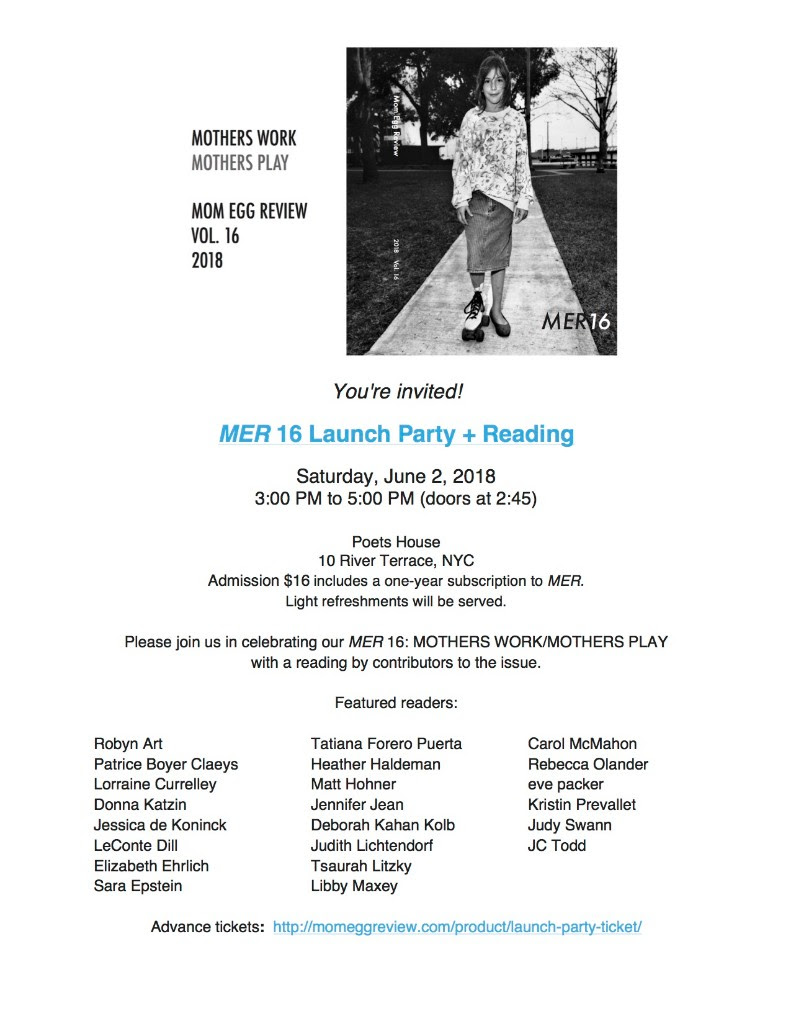
SPECIAL MOM EGG REVIEW READING ON JUNE 2nd in New York!

Sixteen Already?

We’re excited to be celebrating our 16th year of publication with a reading at Poets House featuring contributors to MER Vol. 16: Mothers Work/ Mothers Play. We couldn’t have gotten to this point without the support of many people. Thank you to our editors, editorial readers, volunteers and contributors for helping us publish the finest writing about motherhood. Especially, thank you to you, our readers! We wouldn’t be here without your support. We hope to continue presenting fine work for years to come.

We’d love it if you were able to come and celebrate with us on June 2nd. Ticket link is here.

Looking forward to a fabulous event!

MAMA_Logo_2015

The Museum of Motherhood, the ProCreate Project, the Mom Egg Review, and the Mother Magazine are pleased to announce the launch of a bi-monthly international exchange of ideas and art. M.A.M.A. will celebrate the notion of being “pregnant with ideas” in new ways. This scholarly discourse intersects with the artistic to explore the wonder and the challenges of motherhood. Using words and art to connect new pathways between the creative, the academic, the para-academic, the digital, and the real, as well as the everyday: wherever you live, work, and play, the Art of Motherhood is made manifest. Download the Press Release here or read about updated initiatives#JoinMAMA  @ProcreateProj  @MOMmuseum @TheMomEgg

Categories
AEHK Art Blog Featured Feminism International Residency

Just in time for Mothers’ Day 2018 [LINK]


NEW MEDIA FEATURE: Read the full article HERE or by clicking this LINK

EXCERPT FROM AUTHENTIC FLORIDA ARTICLE:

In 2010, Rose, aided by a team of academics and businesswomen, started the first ever Museum of Motherhood on the Upper Eastside of Manhattan. Relationships with local universities followed and students became interested in studying the art, science, and history of mothers, mothering, and motherhood. M.O.M. (as it is known), became a destination point for thousands of travelers in New York City.

In 2017, Rose moved the museum to the Artist Enclave of Historic Kenwood (St. Petersburg, FL) so she could continue her work and be nearer to her sons. A 1920s bungalow serves as an artist residency space for ongoing exhibitions on motherhood, where students and researchers further their work about mothers and families.

#AuthenticFlorida l Celebrate M.O.M: Museum of Motherhood in St. Pete, FL – JUST IN TIME FOR Mothers Day!! #MOM #MothersDay #Motherhood #ArtofMotherhood #Residencies @StPeteArts @AEHKstpete

DESPERATE ARTWIVES Public TO 2018 (Downloadable PDF)

DAW Takeover:

Desperate Artwives in collaboration with artist Susan Merrick invite you to the next Public Takeover– exploring women’s visibility/invisibility within the workplace. By placing DAW in highly recognized patriarchal spaces, the Takeover aims to respond to issues women & mothers face in the workplace, not least the gender pay gap and gender assumptions around childcare. Our action will also include a connection to the invisible and undervalued work in the home that is still undertaken mainly by women.

o WHEN: Friday 11th of May
o WHERE: meet at 11:45am at BANK Station the action will start at 12 and ends at approximately 12:45 London, England
o WHAT: Takeover Bank area by covering ourselves with a domestic item of fabric (any shape, any colour) and stand still for the duration of the action. People joining social media can choose their own space to take over.

Remember to use all hash-tags when sharing your images on social media.

  • #desperateartwives
  • #publictakeover
  • #uniteddespitethedistance
  • LINK

READ OUR MAY NEWSLETTER ONLINE HERE! HAPPY MOTHERS’ DAY ONE AND ALL! LINK

MOTHERS’ DAY EVERY DAY: Don’t forget, you can make a last-minute gift to your mother by adding her name to our TRIBUTE wall. Your testimony lives in perpetuity and we’ll send her an authentication of your message via e-mail or snail mail (whichever you prefer). Find out more: LINK
Categories
Art Featured International MAMA

M.A.M.A. Issue 28: Left Overs – no more with Rajaa Paixão and Oz with Gwen North Reiss

Statement:

Rajaa Paixão’s art practice tackles a conceptual and multidisciplinary approach, mainly encompassing sculpture and painting, turned into assemblages.

Having an overly dreamy and idealist nature, her thoughts tend to be too erratic and therefore overlapping, resulting in the abstraction and blurry perception of events, contrasted with the urge to reorder physical objects neatly, and naturally, the need to examine divergent themes.

Rajaa’s work process resembles a reverse visual digression, exploring the limits of her memory and imagination, and sharpening indistinct feelings through a dissected analysis of the subject; with the purpose of demystifying the complexity of an event and minimalising thematic narratives by stripping it to its essentials.

The choice of unconventional and diverse materials results from the study of the topic and the inspiration behind it. The role of a base/structure to hold or present the work is as essential to her as the artwork itself; and she only feels that the work is finished when both elements merge into one sculpture, with a clear correlation between all the displayed pieces.

“Becoming a mother was a massive challenge to reconcile my art process with my new status and responsibilities, and reintegrate creation in my daily life. It also changed the way I look at life and respond to change, something I’m happy to embrace and translate in my future work. I am currently exploring safe materials further, and implementing new techniques, which will allow me to maintain my practice in the presence of my son.”

Selected Projects:

– Left Overs no more

The body of work consists of an installation of 3 pieces encompassing painting (at times using one hand while holding a baby or rocking a pram with the other), and sculpture, using contrasted materials and techniques to create organic and industrial shapes.

Bringing together unfinished works and what seems to be an eternal work in progress, the artworks respond to the theme of Sanity and Motherhood, or what’s left of it.

The result involves a long process of what resembles an artistic therapy, in an attempt to extrude trapped emotions on canvas, morphing unconscious thoughts into a colourful interpretation, repetitive and identical gestures; assembled to create inner order, achieved in short saccadic intervals of interrupted time.

Echoing a prolonged chaotic mental and physical metamorphosis, the pieces reach a state of being almost finished, on the verge of being made sense of, figured out, endorsed; only to be soon hit by a triggered, sudden and uncontrollable wave of irrational fear backed with fury, spreading “like” fire, consuming every bit of vulnerable order recently restored.

The end result betrays an illusory freedom being brutally stripped off, the lie of being a separate and defined entity, provoking a loss of control and irreversible frustration, transferred onto the work.

What seems to be a hanging promise of accomplishment, just like the postpartum body and mind, displays signs of visible damages and cracks, hinting to the extent of the invisible ones.

In the end, each imperfect left over from an unfinished work manages to find balance and a purpose in filling a supporting role in the birth of a new coherent and complete entity.

– Berlin 78 Days Backwards

3 pieces tackling an impossible hypothetical yet actual attempt of a trip, using the power of physics and surrounding forces such as black holes, time and the speed of light.

A story about missing an art trip to Berlin, and deciding to travel virtually. The work result consists of a time machine (with hints to a torture tool from all the waiting and stressing), light and sand incubators, ‘theoretically’ meant to catch the light through a mirror and make the sand level rise, allowing the powers of physics to do their magic, and a black hole sound piece with a distorted recording of the unlimited calls made to the German Embassy.

M.A.M.A. 28

More about Rajaa:

Rajaa took part in several group exhibitions across England, and was an artist-in-residence at They Eat Culture in Preston, UK, in addition to attending evening classes, Psychoanalysis after Freud, at the Freud Museum, London. She studied a Master of Arts with emphasis on European Art Practice at Kingston School of Art, London, and has received 4 years tuition in Neoclassical Sculpture.

Instagram @rajaapaixao

OZ

By Gwen North Reiss

Like Dorothy you imagine
that someone will give you,
will have the power to
grant, I think was the word,
what you most want,
one thing that was so clear
when you started out
before you met all of these others,
before the dog met all of these others
who also searched for one thing.
You know the list, a heart,
courage, a nervous system etc.,
a way to get back to Point A.
The shoes were key—
the ones worn for a while
by an evil one and now irreversibly
yours because of the violent way you came
into this world, with feet,
fully formed. You were a bit rumpled,
and so serious, staring—
What an entrance! —
while others giggled and cooed
and asked who must you be.
You knew all along, but you had
to tell them in so many words,
reminding them at every turn
when you started walking,
when you reached the city,
and discovered the truth
about the great one.
By then they knew you well
enough to help you explain.
And you knew what they wanted
and knew what you would miss
about each one of them
when you left—or got back
whichever it was.
The day wishes were handed out like prizes
the great and powerful disappeared
in an instant, waving and yelling97

MAMA_Logo_2015

The Museum of Motherhood, the ProCreate Project, the Mom Egg Review, and the Mother Magazine are pleased to announce the launch of a bi-monthly international exchange of ideas and art. M.A.M.A. will celebrate the notion of being “pregnant with ideas” in new ways. This scholarly discourse intersects with the artistic to explore the wonder and the challenges of motherhood. Using words and art to connect new pathways between the creative, the academic, the para-academic, the digital, and the real, as well as the everyday: wherever you live, work, and play, the Art of Motherhood is made manifest. Download the Press Release here or read about updated initiatives#JoinMAMA  @ProcreateProj  @MOMmuseum @TheMomEgg

Categories
Art Featured International MAMA motherhood

M.A.M.A. Issue 27: The Muteness and the Scream & When You Were Wild

The Muteness and the Scream
Carolina Brunelli

I have always believed in Art with a purpose. I have always believed that I needed a motive, a driving force of social change for my creative process to make sense. When I saw myself pregnant that feeling had simply gone. Perhaps by irony, the patriarchal oppression that I have never acknowledged in my own life, paralyzed me and the torrent of the classical dual feelings of motherhood threw me in a black hole. I no longer saw myself as an individual, a woman, an artist, nor could I see myself as an autonomous being.

This process of turning back to my old self took me three years. It was three years of creative labour to get through the cowardice of patriarchy that oppress women, creating an invisible work force for the perpetuation of the human life, shutting up feminine strength and independence. However, in my situation there is no specific villain, there is no false dichotomy of good and evil, only the branding print in the collective subconscious that women are responsible for raising their children.

Carolina Brunelli

During those three years, I had lost my identity and did not know where to start to get it back. That is until I came across “an Artist Residency in Motherhood”. This residency helped me uncover that I could unglue myself from the symbiosis that is to be a mother and retrieve my identity. My driving force of creation was slowly coming back. It has shown me that Motherhood is a fertile ground for social change and I could finally see that I was not the only one feeling this particular way. Through different readings from other artist mothers, I realised that what I was actually searching for was not an excuse to work, but a good enough excuse. It was not about the patriarchal oppression of feminine exclusivity in raising the children, nor the unfair share of the children´s care, even less the lack of the State support in the form of day-care and schools. It was finally clear to me, that I muted myself because of the lack of recognition of the artistic labour as a worthy enough labour for me to outsource the daily care of my son.

I´m an artist and I´m a woman. I believe in Art as a living force of change. For me, being a mother was not only to yield to all the patriarchal conjecture but to disbelieve in all those special values that made me who I was before, nullifying my own self. Using Art as an instrument and the Residency as catapult, I could see myself as a woman again, independent and above all as a capable individual.

I believe now that I should share this overwhelming experience of imprisonment and freedom. I should go out of my cocoon and show, through everything that I lived the importance of dealing with the Motherhood thematic in Arts. Motherhood needs to cease to be a taboo, to be unwelcome and shameful and can finally reach femininity´s real symbolism of ancestry strength.

Thayná Bonin, a special old friend, who is such a sensible photographer, suggested that her and I could co-create a project to deal with all these issues. Therefore, we have created a photographic manifesto to expose Motherhood in its deepest rawness and awkwardness, but also beauty.

PHOTOGRAPHIC MANIFESTO ART AND MOTHERHOOD

We open the door and invite you to see the shadows, shadows from the story of a woman surviving motherhood on a patriarchal society.
We recover what mother-being has of most human and instinctive, we search for the access to our lost ancestry.

Surviving motherhood on a patriarchal society is painful.
In this society, being a mother means always feeling guilty and tired, to do the job of a whole of society alone.

But beyond the oppressions being a mother is also being able to fight, to survive, to reinvent oneself and to reconnect to our inner nature and strength.
These photos are a manifest, they invite you to look at mothers with compassion, humanity and love.

They are an instrument used to seek a new identity, they deny the bourgeois myth of the all-loving, all-forgiving and all-sacrificing mother and try to reach that touching point of two distinct beings with their own dreams and wishes, passions and fears.
They bring humanity back to the women-mothers, putting them back in focus, the place where they belong in life.

We believe photography can transform and empower the way women see themselves as a woman and as a human being. We hope that through this personal experience of patriarchal oppression we can reach other women and mothers, and that together we can be stronger. Art can be powerful.

Let us rise.

Carolina Brunelli
Thayná Coimbra

L.B. Williams

WHEN YOU WERE WILD   

(after Louise Erdrich)

When you were far away

snow fell green

Where trees were white hoary mountains

When three hundred year old men

could sleep beneath eagles

and become boys again

When I called to you

my voice at first a whisper

When all the mandrake roots were

taken from the earth

When a wind sighing chant

brought you to me.

Originally published in Mom Egg Review Vol. 13

L.B. Williams is the author of, Letters to Virginia Woolf, (Hamilton Books, 2005). Her poetry has appeared in such publications as Washington Square, Mom Egg Review, Sunrise from Blue Thunder (A Pirene’s Fountain Anthology). She has also published two poetry chapbooks, Sky Studies, (Finishing Line Press Fall 2014), and The Eighth Phrase (Porkbelly Press, October 2014). A new poetry chapbook, In the Early Morning Calling, is forthcoming this year from Finishing Line Press. She is Professor of Literature at Ramapo College of New

Jersey. Www.letterstovirginiawoolf.com

MAMA_Logo_2015

The Museum of Motherhood, the ProCreate Project, the Mom Egg Review, and the Mother Magazine are pleased to announce the launch of a bi-monthly international exchange of ideas and art. M.A.M.A. will celebrate the notion of being “pregnant with ideas” in new ways. This scholarly discourse intersects with the artistic to explore the wonder and the challenges of motherhood. Using words and art to connect new pathways between the creative, the academic, the para-academic, the digital, and the real, as well as the everyday: wherever you live, work, and play, the Art of Motherhood is made manifest. Download the Press Release here or read about updated initiatives#JoinMAMA  @ProcreateProj  @MOMmuseum @TheMomEgg

Categories
Art Featured Feminism International Literature MAMA motherhood Residency

M.A.M.A. Issue 26: Welcomes the NEW YEAR – 2018 with Melissa Thomas and Megan Merchant

Artist: Melissa Thomas

Last month Melissa Thomas had a piece of reflective non-fiction writing published on the Mom Egg Review website in relation to her salt labyrinths work. Her latest projects some are due to be exhibited at the Shelf gallery in Cambridge, England in January 2018.

The Mother and the Lemon.

As the sun glows, radiantly flowing through the bedroom window, my daughter wakes by the dawns glimmer to ask if I remembered to buy lemons to make lemonade. In the bright morning light, before the displacement of home life, the kitchen is silently prepared with equipment set in place where two bags of lemons rest in the fruit bowl. Lined up on a chopping board like a diagram of the solar system, each lemon is a surface of its own. Displaying an intimate citrus topography, woven together in similarity through the common characteristics of colour, texture and markings, yet, subtly unique in appearance. Reminiscent of a fingerprint, each inimitable indentation is as distinctive as the dots of pores upon skin. Sliced around the plump centre each half is squeezed, extracting its juice for the recipe. Once the liquid is retrieved, I scoop out the remaining flesh, separating it from the dimpled, delicate rind. The scent arising from the anatomised lemons is sharp and sour, permeating the air and nostrils. Cleansing the debris of domestic duty, they become miniature vessels of material gift, bearing ripe nourishment for the senses.

Through the process, the fruit of the lemon is altered into a pile of translucent skin and fragments of flesh. Examining the squashed segments, soft and pulpy in their consistency, the texture induces memories of a placenta. A life sustaining organ, transferring nourishment from one source to another, the placenta is the forgotten phase of birth. Once a baby has arrived, we do not tell stories of the afterbirth, it remains an invisible entity, labelled as medical waste. Alternate meanings and values attached to the symbiotic unit of a baby and its placenta deviate from the codes of accepted social boundaries, rigidly defining normality. The placenta belonging to my youngest child was shaped like a heart, coloured in rich and vivid shades of crimson, sheathed under the loose and wrinkled pinks of membrane, mapped by sprawling thick blue hues of veins. Rooted at the centre, the thick, white umbilical cord, a twisting helix extending like a bridge between mother and child relays communication unheard.

The touch of my skin against the lemon remnants evoked the residue of the experience of birth. The lemons possess a gestational quality that render the juice amniotic, the pips translate as foetal. Attached to the interior, gentle compression enacts effacement as the seeds emerge in continuum. The dried pips are arranged in three lines, neatly spaced one after the other. They become pauses in the dissection of the fruit, punctuation marks to the story, commas dividing a sentence, separating items on a list; peel, pith, flesh, juice. A composition of the inbetween, they highlight negative space, drawing our attention to the blank. How does something emerge from nothing? Categorisation offers a framework to deduce quantitative meaning. Individual components become labelled and isolated from the whole. Mother, daughter, womb, placenta. Where does one begin and the other end? The linear route of experience ruptured the moment she crowned, transpiring from my body, taking with her the comfort of what is known as I exploded into a new realm, reverberating as the hot nebula of a celestial sphere. Reintegration within the symbolic apparatus of language required my children to become gramma within my story, interspersing the concrete with the fluid, subverting boundaries.

Each persistently fruitful contraction acts as a messenger, despatching significance between the body and mind in a language we must decipher. Fluently breathing through each tightening of her muscular uterus she dressed slowly, preparing to relocate to hospital. Shifting through this passage of momentous transfiguration together, we strode down the wide, white corridors side by side, each step asserting strength and fortitude. The labour room is small and square, decorated with attempts to neutralise the clinical atmosphere; colourful painted pictures filtering the bright daylight through the window, fairy lights strung across the wall in celebration. Rather than blending a sense of unity, the differences seem to contrast. Two ideological philosophies jarring against one another, a nexus located in the physicality of birth, unravelling around the mythic quality of experience. A sonogram affirms the elusive positioning of the baby wriggling in her womb; transverse. Validation becomes immediately distinguished, she had known all along. The emotional apprehension dissipates as the course ahead becomes clear and consent for a caesarean is acknowledged.

The operating room is bright and busy. Her naked skin sits at the centre of bustling bodies veiled in sterile overcoats, manoeuvring between the concentrated landscape of wires and machinery. I observe the surgeon’s fingers tracing the ridges of her spine as the positioning for the needle is located and anaesthetic administered. Sitting by her side, caressing her soft arm, the process is quick and smooth. A green screen draped between her torso and the surgeons work creates the illusion of two halves. A mind and a body divided at the centre, I witness her wholeness through moments of disarticulation. She is the centre of the universe as tears roll down her cheeks like rain falling from the clouds, nourishing the fertile soil, eternally giving and receiving. The baby nestled sideways within her womb, emerges purple and quiet, safely tucked inside her gown, skin to skin. The surgeon begins the process of suturing her abdomen, each layer of flesh dexterously adjusted under the bright overhead spotlight. With nimble hands, a threaded curved needle draws the deep incision together into a rippled seam tracing the contour of her swollen uterus, a threshold on the edge of the fabric of creation.

I returned home in deep exhaustion, my body heavy in a haze. Romantic and visionary ideals of expectation are torn away by the wild, bold autonomy of parturition. There is no personal, there is no political as division dissolves, blurring dreams and nightmares. I awake. Upon the floor, next to my bed there is a single lemon. I stretch my legs to begin the day and I stand upon its oval shape. Beneath the weight of my body, the fruit splits across its ellipsoidal meridian squirting citrus juice onto the soft, beige carpet. I pick up the injured lemon, its form encased within the palm of my hand, bearing resemblance to a tiny body, perhaps of a bird or a small mammal. With flesh and liquid contained beneath its surface, it appears to be breathing. Squeezing the supple, waxy peel between the gentle pressure of my fingertips, the pulp contracts and expands, it’s alive. Transformed into a subject, not solely an object, becoming more than an ingredient for culinary, domestic or medicinal purposes but emerging from its own stories and history.


June 2017 Melissa Thomas

Poetry by Megan Merchant

Working the Night Shift


String a white sheet

from the body of trees

in the wild,


set a lantern

behind its screen

and wait


for the flush of

mottled wings

to lisp and net

the light,


note how some

are frayed as

edges of a rug

beaten against

wind,


how the brightest

markings allow

the most brazen

behavior,


a wingspan—that if

crumpled

inside a mouth—

will tart a tongue.


Wait as they collect

like silk eyes

twitching,


paper darts

that shred rain,


and can trace the scent

of a wounded leaf

to know where

to slip their young

safely.


Wait long enough

and they will show

you how to be reborn

into night.

From Mom Egg Review Vol. 15 2017

Megan Merchant lives in the tall pines of Prescott, Arizona where she spends her days exploring, drinking too much coffee and avoiding the laundry.

Her poems and translations have appeared in publications including The Atlanta ReviewKennesaw ReviewMargieInternational Poetry Review, Diode  and more.  She holds a MFA degree from UNLV and was the winner of the 2017 Beullah Rose Poetry Prize, the 2016-2017 Cog Literary Award and the Las Vegas Poets Prize, She is a multi-year Pushcart Prize nominee.

She is an editor at the Comstock Review, and the author of four chapbooks: Translucent, sealed, (Dancing Girl Press, 2015),Unspeakable Light (Throwback Books, 2016), In the Rooms of a Tiny House (ELJ Publications, 2016), and A Thousand Paper Cranes(Finishing Line Press, 2016).  Her first full-length collection, Gravel Ghosts, is currently available through Glass Lyre Press and was awarded the 2016 Best Book Award.  Her second full-length poetry collection, The Dark’s Humming, won the 2015 Lyrebird Award and is also available with Glass Lyre Press.

Her first children’s book, These Words I Shaped for You, is now available with Penguin Random House

http://meganmerchant.wixsite.com/poet/about

MAMA_Logo_2015

The Museum of Motherhood, the ProCreate Project, the Mom Egg Review, and the Mother Magazine are pleased to announce the launch of a bi-monthly international exchange of ideas and art. M.A.M.A. will celebrate the notion of being “pregnant with ideas” in new ways. This scholarly discourse intersects with the artistic to explore the wonder and the challenges of motherhood. Using words and art to connect new pathways between the creative, the academic, the para-academic, the digital, and the real, as well as the everyday: wherever you live, work, and play, the Art of Motherhood is made manifest. Download the Press Release here or read about updated initiatives#JoinMAMA  @ProcreateProj  @MOMmuseum @TheMomEgg

Categories
Art Books Conferences Feminism International Literature Media motherhood Residency Spiritual Motherhood

About the Artist & Founder

Martha Joy Rose (call me 'Joy') is a scholar, artist, curator, and activist. She She founded MaMaPaLooZa, after touring with her band Housewives On Prozac (1997-2008). She is the founding director of the Museum of Motherhood.

Martha Joy Rose (call me ‘Joy’) is a scholar, artist, curator, and activist. She She founded MaMaPaLooZa, after touring with her band Housewives On Prozac (1997-2008) and began work on the Museum of Motherhood (MOM) in 2003. She holds an advanced degree in mother studies from CUNY, GC, is the NOW-NYC Susan B. Anthony awardee (2009), has lectured extensively, written widely, and served as publisher for numerous mom-made publications. Joy has also been featured in the Tampa Bay Times locally as well as WEDU, PBS, ABC News and nationally on Good Morning America, CNN, and NPR. She is the NOW-NYC recipient of the Susan B. Anthony Award, her Mamapalooza Festival Series has been recognized as “Best in Girl-Power Events”, and her music has appeared on the BIlboard Top 100 Dance Charts. Her current live/work space in Kenwood is devoted to the exploration of mother-labor as performance art. She is an ‘artist recipient’ of a grant from St Pete Arts Alliance & in 2023, she was certified with the Adult Mental Health First Aid, USA. She is the mother of four adult children and five grandchildren.

Diary of a Curator

9:30 AM. I am a cheerleader with a cup of coffee in hand, at my desk, dressed in underwear, checking e-mail. The young intern in Southeast Asia, who is conducting research as part of a special project for the Museum of Motherhood is having an issue getting access to the women who have been traumatized by rape, displacement, and other human rights violations in Myanmar. She wants me to look over her proposal. A senior in in high school, she believes in humanitarian activism. It is only 9:30 am and we are mothering the world.

12 PM Pause for olives, crackers, kombucha, and seltzer. Nice ice spills on the floor as my phone rings. Daughter wants to video chat from San Francisco on her commute to nursing school, then back to my computer. 3-hour time difference.

1 PM Sift through the student e-mails which begin with “Dear Professor Rose, I am so sorry I forgot to turn in my homework on time,” and are followed by a variety of excuses, most of which are not worth sharing.

2 PM Urgent phone call from a friend. Her voice quivers. “Can you talk?” She apologizes profusely. A secret story spills out. She keeps asking, “Am I crazy?” She’s in the car, with her daughter, leaving her husband. She says she is not safe and needs advice and a divorce attorney. I refer her to one and also the Pace Women’s Justice Center.

2:30 PM Text to my friend. “You are strong.”

3:00 PM Talk to my sister. Grab a cookie.

3:30PM Fingers on keys. I have a theory. I am a woman of many collected years, who has raised four children to adulthood. My circle is comprised of mothers, many who suffer periodically from anxiety, depression, and even mania. (I have had my episodes too). We are the women, forty to sixty years old who have spent our adult life feeding babies, changing diapers, and fretting over young progeny. We work, we take public transport, and if we have cars we drive. We try to sleep. We keep a grueling pace: the caregivers, the mothers, maybe now the fathers, but mostly the mothers whose bodies feel the vacant place where their infants stirred: the real, the imagined, and the yearned for. Trying to heal that deep mysterious hole, prepping children for school, cooking meals, cast, cast, casting spells. We, snap pictures for the prom, or we take them to the hospital, or maybe the worse possible thing happens. We keep so busy. Then, when our youth go off in the world to make lives of their own, all that is left in place of twenty years of directed, exhausting, unrelenting energy is a longing. That momentum, circles back into the heart and mind, funneling a giant vortex that drives some mad – Vigilance! Do not let the madness take hold. Take a deep breath. I am flinging these words, towards the universe in the hopes of reaching your collective soul. Take heed, I beg you. Find a way to fill yourself.

4 PM I draw a sketch of a small statue. She is a victorious woman made of steel with a V-up and V-down. Tomorrow, I go to town to procure rebar, followed with a lesson in welding, from a young man who works in a car factory, who has gifted me with a stick welding machine from 1957. “Can you give me lessons,” I ask? “Sure,” he replies. I place the drawing on the desk and stare at it. The fire burns hot.

5 PM Stirring a pot. Cooking the dinner. Watching the soup spin. I anchor my artistic practice to scholar Sarah Black’s assertions that argue for the position of “mother as curator.” Everyday activities equal the sum of our labor on behalf of the flock, as well as our art, and collectively we create, enact, and display our creativity.

6 PM I still have mountains of homework to do. I have a book to finish, paintings to paint, and metal to bend. I have a museum to run, my mother’s farm to harvest, a home in New York where the work began. Where the children were raised. Where I made music, was married, and then divorced.

7 PM Chores, water garden, pick up the kitchen. Then, back to the computer.

9 PM More papers. More emails. My eyes are tired. I need to log off until tomorrow.

9:30 PM Shutting down the screen. Brushing my teeth. I am grateful for the women, for IWD, for Women’s History Month, for all the ancestors who made my life possible, and for my mother, grandmothers, aunts, and sisters who inspired me to find this work. To the professors, scholars, and artists who helped me understand the world, I live in.

10 PM One last thought, as I lie in bed, in the dark, when the quiet is so thick it feels like an eternity. In the house where my parents lived and died, in the bedroom that was theirs for twenty years after they moved here, next to a field where relatives from Scotland arrived in 1832, where the blackness swallows the light, I say my prayers. I call out for help, invoking my angels, lighting a candle, blessing my children wherever they are (because I cannot tuck them in anymore), and then I wait, slumbering, for strength to find me again, which invariably it does.

Martha Joy Rose; IWD Women in Herstory 2023 (Shared from a 2019 post)

10 AM Log onto the Manhattan College online. Grade papers for the Sociology of Family class. I am teaching fifteen students this summer. They are all boys. I am teaching them Mother Studies. We recite the names of the Female Founders one by one committing them to memory, first the feminist leaders, then their theories, then, the scholars, eventually the artists. I cite the quote from Adrienne Rich: “The one unifying, incontrovertible experience shared by all women and men is that months-long period we spent unfolding inside a woman’s body. Yet, we know more about the air we breathe, the seas we travel, then the nature and meaning of motherhood.” (Of Woman Born, p 11)