Lately, it seems, there are so few words to describe our current world. Mother earth is in shock even as mothers across America celebrate this holiday made virtual. So many of us cannot spend the day with our adult children due to social distancing while other families are overwhelmed with responsibilities, hunger, homeschooling, exhaustion, health, and a host of issues.
So, what do do?
Sometimes, in the quiet, we find hope for a new day. Here at MOM, our prayers, light, and love shine through even though we too have been largely silent. If you would like to register a mother you love on our Tribute Wall you can do so here at this link (by making a small donation to MOM. Happy Mothers’ Day and please do stay safe, healthy, and blessed!
_
Joy Rose and Mom International Mothers’ Day Shrine
Mothers’ Day was first celebrated in 1908 when Anna Jarvis held a memorial for her mother at St. Andrews Methodist Church in Grafton, West Virginia (now the International Mothers’ Day Shrine). In 2014, I had the great honor of speaking at the 100 year anniversary of the creation of the shrine and commemoration of the official holiday with my mother in attendance. Items and ephemera from that occasion are currently housed in the MOM Art Annex in St. Petersburg, Florida.
When families have to hunker down and stay put with their kids out of school, community contacts are restricted, and the workplace is disrupted, we must do everything within our power to stay positive.
When healthcare concerns trump everyday freedoms, each of us must look to the future and how we can make things better.
When Kimberly Seals writes an article for a widely-read publication about the often difficult and unpaid labor of caregivers, I pay attention.
Her recent article for #WomensHistoryMonth is online at the #WashingtonPost here.
I feel grateful to have contributed to this piece.
I feel grateful to you for reading it.
I feel grateful to live in her world (and yours).
I feel grateful to #teach #MotherStudies.
While you are spending more time social distancing, may you and your loved ones have food, may you and your loved ones have shelter, may you and your loved ones be well, may you keep the light of love inside you.
With Great Affection,
Martha Joy Rose
Get woke. Or, at least, well read: For your personal reading list, or if you’re in a book club, Rose suggests including titles that examine motherhood in a historical, racial or cultural context. She specifically recommends “Motherhood and Feminism” by Amber Kinser; “Reproducing Race” by Khiara M. Bridges; “Black Feminist Thought” by Patricia Hill Collins; and “The Price of Motherhood” by Crittenden. Take a six-week class with the Museum of Motherhood, or attend an online event this month. KSA
Kimberly Seals Allers and Martha Joy Rose at the Annual Academic MOM Conference in NYC
This month marks the International celebration of Women’s Day (Sunday, March 8) and Women’s History Month.
Both of these acknowledgments demonstrate an earnest desire to understand and honor the contributions of women. Wednesday, March 11th will mark the opening event for a new exhibit at USF, Women’s and Gender Studies Dept., curated by Martha Joy Rose.
Panels featuring the four waves of feminism flank the entrance to the exhibit titled The Founding Mothers: Women in Herstory. Also on exhibit are a myriad of art pieces including works by Rose, Christen Clifford, and Kim Alderman. This timely installation brings together feminist voices throughout herstory who have challenged conventional attitudes about gendered performance and motherhood through their writing, activism, and art. A multi-media interactive exhibit encourages participants to think critically about evolving family narratives and womyn’s place in society.
Please do come visit. See the impact Mother Studies can have on your life, perspective, and the future. Write INFO@MOMmuseum.org for more info. Flyer for the opening event is here. The exhibit will be up through May 8, 2020.
See more panels here online at the Museum of Motherhood: LINK
Bio: Anna Perach’s practice is informed by the dynamic between personal and cultural myths. She explores how our private narratives are deeply rooted in ancient storytelling and folklore and conversely how folklore has the ability to tell us intimate, confidential stories about ourselves. In her work, She synthesizes female mythic characters and retells their stories while placing them in the current climate. By doing so Anna creates an experience of eeriness, evoking a sense of both familiarity and distress.
Anna’s main medium of work is wearable sculpture and performance. She works in a technique called tufting, making hand-made carpet textiles that she transforms into wearable sculptures. The sculpture functions as both a garment that is performed in as well as an independent sculpture. Through this choice of medium Anna is interested in exploring how elements associated with the domestic sphere operate as an extension of the self and reflect on one’s heritage and gender role. Her performances reverse this dynamic and exhibit the private domestic carpet as an external masquerade both exposing and hiding fragments of the self.
ALKANOST: tufted yarn and hand embroidery, 80x130cm, 2019
Jane Yolen will have published over 376 books by the end of 2018. She has worked in almost every genre possible. Her books include several NY Times bestselling children’s picture books, prize-winning short stories, and poems. Six colleges and universities have given her honorary doctorates. She was the first writer to win the New England Public Radio’s Arts & Humanities award. She’s mother of three (all in the book business) and grandmother of six.
“Scars” by Jane Yolen was previously published in Mom Egg Review Vol. 17, 2019.
TheMuseum of Motherhood, the ProCreate Project, the Mom Egg Review, and the Mother Magazine are pleased to announce the launch of a bi-monthly international exchange of ideas and art. M.A.M.A. will celebrate the notion of being “pregnant with ideas” in new ways. This scholarly discourse intersects with the artistic to explore the wonder and the challenges of motherhood. Using words and art to connect new pathways between the creative, the academic, the para-academic, the digital, and the real, as well as the everyday: wherever you live, work, and play, the Art of Motherhood is made manifest. Download the Press Release here or read about updated initiatives. #JoinMAMA @ProcreateProj @MOMmuseum @TheMomEgg
If you look back on the history of birth in the U.S., 95% of infants were born at home with midwives. Promptly after birth, the child was placed on the mothers’ breast to nurse. Today, many women seem to doubt their ability to give birth naturally and breastfeed. Often society does little to support them.
Many women desire to breastfeed and though the rates have slowly been rising research shows there is still a decrease in breastfeeding rates from birth to one-year. A quick google search will show you why there is a decrease. What is not listed amidst the CDC research is how women have been taught to not trust their bodies.
In America, it is more common (and comfortable) to see women advertised in lingerie and skimpy clothing. At the same time, a woman nursing in public can publicly shamed or experience feelings of discomfort, or be judged critically. Nursing mothers are still evicted from public spaces, restaurants, and they encounter rude comments when strangers express they do not want their child(ren) exposed to breastfeeding. Although breastfeeding is what our bodies are designed to do, it can be awkward and has been referred to as something to be socially discreet about.
As a mother of three boys, I would rather have them grow up knowing breasts have a purpose. Women’s bodies are uniquely formed to feed babies and also to comfort them. Additionally, nursing a newborn helps with psychological development (and so many more other beneficial things).
In some communities, mothers have access to breastfeeding help through groups like La Leche, as well as breastfeeding cafes and mother support groups. Still, some mothers struggle. It could be that many mothers continue to get false information from health care professionals who are not educated about lactation, and though health care professionals mean well, they sometimes insinuate that mothers should not trust their bodies.
All breastfeeding mothers should have access to local references from lactation professionals and be free of cruelty and judgment. If an advisor is not available, then there are other ways to connect to professional consultants including email, phone, and video chat. Unfortunately, these options are not always promoted. Many health care professionals unintentionally perpetuate myths about breastfeeding. For example, I have heard of women being told that breastfeeding can hurt; NO! Breastfeeding should not hurt! If it does, then it is a signal that something may be wrong and the nursing mother should seek help from an IBCLC. There are so many myths that continue to be perpetuated. Here are a few listed online courtesy of the United Nations International Children’s Emergency Fund, UNICEF [LINK].
Even with available resources, some mothers of young children struggle just getting out of the house. They’re tired, overwhelmed, and are dealing with a mixed bag of emotions. If they have a messy house on top of that, they may not want to entertain visitors. Believe me, no one coming to support or assist a mother with nursing is spending their energy judging a messy home. (My own kitchen has been not been cleaned since I had my first son 8 years ago and yet, I continued to have more children)!
In this shared graph from Katie Hinde, an Associate Professor of Evolutionary Biology and Senior Sustainability Scientist at Arizona State University, and a researcher of lactation, she shares on this brief clip on Ted Talks what little we know about breastmilk compared to other subjects.
She shares this powerful message, “Many mothers do not reach their breastfeeding goals, that is not their failure, it’s ours.”
Do nursing mothers have rights? Yes, they do. But in 2019 some mothers still struggle with being told they can not nurse in public. As recently as this summer, a woman in Texas was told she could not nurse her baby at the public pool. Even though this mother knew hew rights, this issue escalated quickly and police were called to the scene. A breastfeeding mother has rights for a reason. These rights should not only be known by mothers but by public servants as well. Government employees as well as other facilities that say they support breastfeeding mothers need to be required to read and understand breastfeeding rights for customers, as well as their employees. This can vary from state to state. Mothers nursing in public helps to expose the general public to an infant’s needs as well as the very natural act of maternal nursing.
Even though some people in the general public may be hurtful, many other breastfeeding advocates will support you. We are mothers, we have the right to feed our babies as we choose, and we will not be silenced for choosing to breastfeed whenever and wherever our child is hungry outside the home.
It can be very frustrating for parents to hear from a dentist, that breastfeeding at night, or night-nursing, caused your child to have cavities. The health benefits of breastfeeding are widely promoted, but information that it might cause cavities isn’t forthcoming. That’s probably because it is may not be true. It can be confusing for a parent to hear from a professional that has studied lactation to hear from a professional that has studied teeth that they simply do not agree. One argues that night nursing isn’t a valid reason to wean, and the other insists on weaning at night because prolonged night-nursing might cause cavities.
I’d heard rumors about people who experienced situations where the dentist suggested weaning at night, but when it came time for me to experience this first-hand, I was shocked. During a tooth brushing wrestling match with my youngest son who had recently turned 2, I noticed, not just 1, but 3 dark spots! There were THREE cavities on his front teeth. I instantly felt pangs of guilt. How could I have caused this? Then, I questioned if I was brushing his teeth enough? Was he getting too much sugar in his diet? Did I not have a good brand of toothpaste? Whatever it was that caused the cavities, I had to get him in to see a dentist immediately so we could understand our options and treat the problem.
When Liam’s father came back from the dentist, he told me, “Well, Liam has cavities because he breastfeeds at night, so you have to stop nursing him at night or brush his teeth when he is done. I guess breastfeeding is just as bad as drinking a soda before bed.”
I felt so angry, I yelled, “I AM SO GLAD I AM NOT A FIRST TIME MOTHER! THAT IS NOT TRUE!”
Of course, his father looked at me like I was crazy. I was just a mom saying that my dentist, who is well educated in the study of teeth, had no idea what he was talking about. Who the heck am I to question what my dentist said? I knew from all the books I had read, podcasts of IBCLCs I had listened too, that this was a topic brought up often, and it was always discussed as a myth. I knew the resources I had to navigate, to share with other mothers stating that this was not true (like here on Kellymom.com.)
I just kept saying to myself, “breastfeeding does not cause cavities!” But again, how could I KNOW this, but my dentist did not? I knew I had an appointment for myself in the upcoming months and I decided that would be the time for me to address all my questions and offer the information I had at my disposal. I liked and respected my dentist a great deal, even though I was angered by what he said. In the past, he had made our family feel comfortable, even though he was a very young dentist.
I asked my dentist a variety of questions on the day of my appointment. First, I inquired about what sources for education on breastfeeding and tooth decay he had access too. Then, I asked how he knew exactly what caused my son’s cavities? Lastly, I wanted to discuss why IBCLCs and dentists don’t agree.
Before answering my questions, I could interpret that he felt uncomfortable and that he was not expecting this kind of conversation. The direct questioning of his authority surprised him. He explained to me that he did not have any lactation education. He then shared a brief description from a study in 1984, of the relation of night nursing and cavities in the book Dental Caries: The Disease and It’s Clinical Management on pages 344-347. Then, he then also explained that when my son nurses at night, the breastmilk may sometimes pool around the front of the teeth, which may lead to the cavities.
breastfeeding baby
I knew what he was describing was baby bottle rot. This is because when breastfeeding, the nipple goes far enough to the back of the throat, which does not leave much room for breastmilk to go anywhere but down the throat. But, before I could say anything else, he quickly reminded me that he supports breastfeeding and that I just had to brush my son’s teeth throughout the night when he nurses. With my last question on why IBCLCs and Dentists don’t agree, he simply did not have an answer for me. This upset me because I felt concerned about other new parents (this was my second child) might interpret the conflicting information available to them.
The 8th edition of The Womanly Art of Breastfeeding states, “There is no evidence that nighttime nursing causes cavities. Other mammals with teeth nurse day and night, and they don’t get cavities.
Dr. Brian Palmer studied children’s skulls that were thousands of years old. These skulls were preserved prior to the invention of toothpaste. He found almost no evidence of cavities. Why would this be? One reason is that “human milk does not pool around the teeth during nursing; it is pulled instantly toward the throat and swallowed,” (Pg. 241).
A lot has certainly changed over millennia of human life, including diets and how we live. But, what hasn’t changed is a baby’s wiring to breastfeed, and to receive human milk. Can breastfed children get cavities? Of course, but saying breastfeeding alone is what causes problems, is incorrect. In my own experience, my breastfed son, who was also introduced to a variety of milk including soymilk, almond milk, whole milk, and was also eating whole foods, I probably did not brush his teeth as often as I should have been. My other son had nursed for almost 2 years and at 5 he never had a cavity. My Dentist did not ask me about Liam’s diet, but as soon as breastfeeding came up, the issue of cavities was blamed on that. I do not accept that reasoning.
I’m sure in both the professions of IBCLC and of dentistry, the newest scientific information is relevant and accessible. But, how often do dentists actually get updated on lactation research? And, how often are we studying this issue? There are breastfeeding-friendly dentists sprinkled throughout the U.S., but not everyone has the means to visit with one.
If you’re experiencing a recommendation to night-wean in order to avoid cavities, it might be best to look for the most recent research. Then, as with everything else, make as informed a decision as possible. Evaluate what works best for you and your family, and make sure you’re wiping your child’s teeth twice a day, especially at night. No matter how you feed your child, you cannot 100% protect them from cavities. But, you can help prevent them as much as possible. Cavities can happen to any child, but breastfeeding alone is not the answer to why children may develop dental problems.
Congratulations to Deann for a recent press article at Cayuga News
Jessica Lauren Elizabeth Taylor Muttererde (2017) Video
Muttererde profiles conversations with five black femmes on the knowledge and non-knowledge of their mothers, grandmothers, great grandmothers and as far back as the knowledge carries them to create a rich and powerful archive on ancestry. They explore themes of motherhood, migration, cultural differences, beauty standards, queerness, kinship, death and rebirth. Their stories, although from five different countries, intertwine to weave a tapestry of herstory through the African diaspora. Through their testimonies, the viewer discovers that ritual, memory and oral history can challenge the status quo.
This work, made in collaboration with filmmaker Astrid Gleichmann, features the stories of Camalo Gaskin, Tobi Ayedadjou, Niv Acosta, Natalie Anguezomo Mba Bikoro and Fannie Sosa. It has been supported by the Decentralized Cultural Work Tempelhof-Schöneberg, District Kunst und Kulturforderung Berlin and A Prima Vista Filmproduktion. Posted in partnership with the Museum of Motherhood, Procreate Project and the Mom Egg Review.
Artist Biography
Jessica Lauren Elizabeth Taylor (b. 1984, Florida) is a multidisciplinary artist and community organizer. Her roots are in the Southern United States, born in Mississippi and raised in Florida. Taylor’s work manifests through performance, text, dialogue, dance and community building for Black People and People of Colour. She is chiefly concerned with ways to dismantle oppressive institutions and the creation of racial equity in art and cultural institutions. She has performed and presented at the Barbican Centre of Art (London, UK); Chisenhale Gallery (London, UK); Hebbel Am Ufer (Berlin, Germany); Kunst-Werke Institute for Contemporary Art (Berlin, Germany); Sophiensaele Theater (Berlin, Germany); The Astrup Fearnley Museum of Modern Art (Oslo, Norway); Rogaland Kunstsenter (Stavanger, Norway); and the Irish Museum for Modern Art (Dublin, Ireland). She is currently undergoing a Master of Art in Black British Literature at Goldsmiths University of London.
VIDEO TRAILER
LANGUAGE CLASS
Kimberly L. Becker, (written on Qualla Boundary; for C.M.)
Little by little
we are reclaiming the words
Just as the land was once large,
so, too, our voice
Some words lost on the Trail
have been found
They lived hidden in baskets,
in pockets, in the very tassels of corn
(Selu, Selu)
Now the words live again
See? When I say nogwo it is now,
both the now of then and the now
of not yet
The words work secret medicine
and strong, forming us
from the inside out
Language is our Magic Lake–
we walk in limping with loss
and emerge wholly ourselves
When Cecilia speaks
she bears with her
the future of these sounds
Listen: her voice is soft, but sure
Originally published in The Mom Egg Vol. 8 Lessons, 2010
TheMuseum of Motherhood, the ProCreate Project, the Mom Egg Review, and the Mother Magazine are pleased to announce the launch of a bi-monthly international exchange of ideas and art. M.A.M.A. will celebrate the notion of being “pregnant with ideas” in new ways. This scholarly discourse intersects with the artistic to explore the wonder and the challenges of motherhood. Using words and art to connect new pathways between the creative, the academic, the para-academic, the digital, and the real, as well as the everyday: wherever you live, work, and play, the Art of Motherhood is made manifest. Download the Press Release here or read about updated initiatives. #JoinMAMA @ProcreateProj @MOMmuseum @TheMomEgg
According to the CDC among the infants born in the United States, 83.8% start to breastfeed and by 12 months the amount of breastfed babies is down to 36.2%.
“A more recent study that used costs adjusted to 2007 dollars and evaluated costs associated with additional illnesses and diseases (sudden infant death syndrome, hospitalization for lower respiratory tract infection in infancy, atopic dermatitis, childhood leukemia, childhood obesity, childhood asthma, and type 1 diabetes mellitus) found that if 90 percent of U.S. families followed guidelines to breastfeed exclusively for six months, the United States would save $13 billion annually from reduced direct medical and indirect costs and the cost of premature death. If 80 percent of U.S. families complied, $10.5 billion per year would be saved. (Economic Effects).”
There are a variety of reasons mothers stop breastfeeding by 6 months including, concerns of milk supply, baby’s weight, issues with latching, unsupportive work policies, lack of prenatal leave, cultural norms, and lack of family support. So, what is a mother to do if she desires to breastfeed? In my previous post I gave an overview of the importance of seeking an International Board Certified Lactation Consultant (IBCLC); because they have received thorough lactation education. IBCLCs can be found in many areas, but many of them are employed in Hospitals, WIC offices, and Private Practice.
In Hospitals where an IBCLC or a Certified Lactation Counselor (CLC) are present, a visit to assist mom with a correct latch with baby, as well as address any breastfeeding concerns, is done during the mothers’ hospital stay. As the baby grows each week after his/her birth the breastfeeding experience can continue to change; bringing new questions on how to know if you’re doing this whole breastfeeding thing correctly! Most Hospitals will assist you during the entire course of your breastfeeding journey. However, some mothers forget that they can receive help from the hospitals IBCLC or CLC staff beyond the newborn stage.
Anna Kell Artwork Nursing_Install; MOM museum online exhibit
WIC participants benefit greatly from having the ability to contact breastfeeding support during pregnancy, after birth and up to the child turning 5. Many WIC offices have IBCLC, CLCs and Breastfeeding Peer Specialists; these specialists are experienced breastfeeding mothers that have undergone some training to assist mothers. At WIC, a parent could work with these available sources with the continued visits required at WIC for nutritional help. Although WIC is income-based and not available to every parent. As well as the fact, that some mothers report it is easier to access baby formula through WIC than breastfeeding help. (Source- Breastfeeding in the Public Arena Pg. 153 MJR).
Private Practice IBCLCs may face more of a challenge with assisting clients due to a conflicting relationship with insurance companies. Insurance providers have a variety of policy plans available to their customers. It may be in your best interest to call your insurance company during your pregnancy to see what is covered with breastfeeding supplies, (like a breast pump) or lactation visits, what documentation will be required, and the time frame you may face while waiting for coverage, if you have any, with your insurance. The information provided by your insurance company based on your plan, which can easily differ from other individuals’ plans, may help give you a better understanding of what you need to prepare for. Many insurance plans require an “in-network” provider, this means the lactation consultant has an agreement with the health plan to provide services. For some private practices, this may be easier said than done. An e-mail survey of U.S. IBCLCs in March of 2011 conclusion recorded that, “IBCLCs provide key care to a vulnerable population. However, we found that these services are not consistently reimbursed. IBCLCs poorly communicate their health care activities to insurance providers, but insurance providers also inconsistently recognize and reimburse IBCLC care.”
I recently interviewed IBCLC Heather Gansky, her practice is The Tree of Life Lactation located in South Carolina. She has also been a La Leche League Leader since August of 2016.
Question: Have you come across mothers experiencing difficulties nursing their baby and insurance companies denying coverage for Private Practice appointments with a Lactation Specialist?
Heather: Yes there are a ton of denials from insurance companies. Most moms do have to resubmit with different codes because each insurance seems to have it own way they like to do things.
Question: If a mother does not qualify for WIC, and is unable to attend La Leche League meetings, where do you suggest she go for assistance?
Heather: If I run into a parent who doesn’t have WIC or can not come to meetings I will either refer her to an IBCLC in our area, myself being one of them on a list about 3 others. Also, there are hospitals that have support groups, and some areas have baby cafés that anyone can drop into for help they need. It really depends on the situation and if she needs one on one help or peer to peer support.
Question: From your experience, how often do you think mothers seek breastfeeding help? Where is the best source for them to turn to address breastfeeding concerns? (Newborn stage, 3 months, 6 months, 12 months, 2 +years.)
Heather: I find mothers sometimes wait too long to seek help for breastfeeding issues. It’s only until they are able to throw in the towel due to pain or poor weight gain in their baby that they actually seek help, and sometimes that’s much too late. Generally, we see babies in the newborn stage-1 month; then again around 3 months when babies really need to be good and suckling and using their tongues and mouths correctly to actively get milk out. If we didn’t see a baby in the early days but see them in the 3-month range it is typically due to mouth abnormalities which went undiagnosed either due to moms oversupply/ overactive letdown and the baby was riding the huge letdown portion of the feeding session.
Question: Do you think insurance companies are helpful to mothers seeking breastfeeding help? Or does the process of waiting for approval leave moms in a position of crisis where they turn to formula feeding, even though breastfeeding was their first choice in how they wanted their baby fed?
Heather: Some insurance companies have staff on hand to help with common issues/questions over the phone. There are some IBCLCs that are in-network for some insurance companies, but most work in offices and don’t do home visits. Most parents need help right away and aren’t waiting for insurance approval. In the case where parents don’t have money to pay for a consultation out of pocket they sometimes can go back to the hospital they delivered at however they are put back in the same situation with the same providers who are time-constrained and didn’t help them, to begin with. Many parents just don’t want to go back to those providers.
Question: Do you think that if health insurance companies were more supportive on coverage for visits with a lactation specialist that there could be a possible increase in breastfeeding rates?
Heather: Oh I’m sure of it. Most families are living paycheck to paycheck. They can’t afford a lactation visit… especially when one or both parents are out of work for the birth of the baby.
Question: Do you think families would benefit from visiting with an IBCLC before baby is born?
Heather:Yes. Education before birth is one of the key factors in initiation as well as the duration of breastfeeding.
The cost of breastmilk itself can be free. However, breastfeeding may have some additional costs. A mother could get around not having a breast pump and could choose to hand express, but meeting with an IBCLC or other lactation specialists may be more beneficial in helping you reach your breastfeeding goals. A visit with a consultant may range in price from $100.00-$300.00 depending on your location, but this is still a very low cost compared to a months’ worth of formula which can cost up to $243.00 per month, or you can use this Formula cost calculator to determine costs. If you plan to breastfeed, and during pregnancy you read the books, attend the breastfeeding classes, you may still want to be prepared to visit with a lactation specialist after the birth of your baby. Requesting funds as a baby shower gift, holiday or birthday, to visit with a lactation consultant would be an amazing gift to receive if you feel you may need help with affording the cost to visit with a consultant. You may be lucky enough to even be reimbursed by your insurance company after these visits, but it is best to save up on your own for a visit to avoid a feeding crisis, then waiting for the insurance to get everything in order. Either way, if you want to breastfeed, that is your choice. Income and Insurance coverage should not be left to chance.
More on education:
Please see the Free Webinars offered through the United States Breastfeeding Committee. The next 11/20 Session: Building Relationships: a Key to the Rise of our Indigenous Breastfeeding Communities
will be presented by Amber Kapuamakamaeokalani Wong Granite, Breastfeeding Hawai’i Coalition.
O ke kahua ma mua ma hope ke kūkulu: First the foundation, then the structure can be built.
This Hawaiian proverb teaches us the importance of building relationships in order to ensure the rise of our people.
Whether we seek to influence fellow learners, patients, or customers, we must get to know them before we can ask them to make a change. Once we seek and understand where they come from, what is truly important to them, and then help them unpack their stories, the real work can truly begin. During this session, we will hear an oli, Nā ʻAumakua. This oli acknowledges our ancestors, our land, and our nation. It invites strength, knowledge, and power into our space. MOM founder and director, Martha Joy Rose has participated in these and found them educational and helpful. (See the certificate at the bottom of the page)
MEET OUR NEW INTERN! Dee Shaffner (Merritt) is a first-time college student at Cayuga Community College in Fulton New York. Dee is currently workings towards her Associates’s Degree in Liberal Arts with a concentration in Psychology. She is a single mother to 3 wonderful (and extra silly) little boys, Lucas, Logan, and Liam. In addition to being a mother and a student, Dee also works at Mother Earth Baby and is a La Leche League volunteer.
We are thrilled to welcome Dee for a remote internship in blogging over the course of several weeks. She will be researching and writing on topics related to motherhood, gender, pregnancy, and breastfeeding. She hopes to gain additional insight from her research and share that knowledge. Her desire to support other mothers stems from her personal motherhood struggles as well as from questions and concerns, friends, mothers, even strangers have approached her about through the years, She will share some of her perspectives as part of her internship for MOM.
GENDER DISAPPOINTMENT: What it is, how it feels, how to handle it.
The day of the gender reveal during pregnancy can be an exciting one! When I went in for mine, I was so confident I was going to have a girl. The ultrasound technician concentrated on my belly as I lay under the thin cotton blanket on the table. Then, suddenly, pointing to the grainy image on the ultrasound screen, the tech announced in an excited voice that we were having a boy. My heart sank. This was not anything I was prepared for, no one ever mentioned to me that I could feel devastated about the gender of my baby, I felt so ashamed. All I could think of was how I was told in classes, and from other mothers, that all the effort and pain from pregnancy and labor goes away and nothing else matters when you hold your baby in your arms for the first time. But, I could not imagine holding a baby boy. I felt shattered.
Lying on the table, hearing the technician’s words, I squeezed my partner’s hand and forced out a smile. After I got dressed and left the room, I convinced myself there could be a mistake. The images were so blurry. There was still a chance my baby would come out a girl. Months later, during the labor and then as my baby was delivered, I heard excited voices announcing, “Congratulations. You have a baby boy!”
I felt a wave of disappointment and a surge of shame. These were the same feelings of shame I felt the first time I was told I was having a boy. I didn’t dare say anything out loud. I forced a smile.
This happened to me 3 times. Yes, I am the mother of 3 boys. Over the years I hoped the desire for a daughter would disappear. I love my children and this is not something I need to defend, but my heart still aches for other possibilities. Gender disappointment by definition is when an expectant parent experiences depression or anxiety when the sex of a baby does not match their preference. As I find myself continuing to struggle with my emotions, I have since learned many mothers and fathers also have gender disappointment. Though the journey is different for everyone, complex feelings, sadness, and feelings of longing are all part of this syndrome.
Admitting to gender disappointment can be hard for anyone. A person may feel hesitant to say much about it because they do not want to be judged by others and be seen as ungrateful or neglectful parents. For myself, feeling ashamed was a heavy weight on my shoulders, I love all my boys, but the love did not come at first sight. I had to learn how to love them. Since exploring this topic over the years, I have come to find out that my experiences were not unique. While expressions of gender-fluid behavior are prevalent in contemporary culture, and a mother can still teach her son to sew and a father can teach his daughter how to hunt, some parents continue to experience a lack of connection. They worry that they will never be able to fully bond with their child.
Social pressure on expecting parents can add even more depressive weight. Hearing from a stranger in the grocery store who says things such as “you already have 3 boys, so you should just give up on trying to have a daughter,” makes my blood boil. I have come to assume that these people, in an attempt to make small conversation, just do not really know what to say and they just repeat what has been said in the past, to them.
Other examples, of perhaps well-intentioned individuals wanting to insert themselves into an individual family narrative, can ultimately be unhelpful or even hurtful. A few of these are:
(You do not have any children.) “Oh, when are you going to have children?!”
(You have 1 child.) “Oh, when are you going to have number two?!”
(You have 2 same-gender children.) “Oh, well your next one will be the opposite gender!”
(You have 3 children.) “You are going to have to even those children out!”
(You have 4 or more children.) “Oh goodness! Your hands are full, you should stop having children!”
The comments can hurt. I would always get so bothered when people would tell me, I am a “boy-mom,” no, I am not just a boy-mom, I am fully capable of being a mother to girls too, I am just not one, yet. And, I may never be, but whether I am, or I am not, the deeply personal decision to have a child or not have a child is not something that is up for public scrutiny, nor are the complex feelings many parents grapple with.
Thankfully over the years, there is more support and literature for parents struggling with gender disappointment. We all love and care for our children intensely. But for those of us going through this experience, these emotions might not ever go away. As a mother of boys, I focus on finding ways to bond with my children even if I am not a big fan of dirt, trucks or farts. I also recognize that as humans develop the nuances of sex and gender do not necessarily follow a binary path. I seek moments of abiding joy and acknowledge the importance of seeing every child for who they are, apart from their gendered behavior.
For me, seeking professional help was also very beneficial, Facebook has supporting group pages, there are articles on a variety of websites that share personal experiences. The book Altered Dreams…Living With Gender Disappointment, written by Katherine Asbery, was a source that had helped me at a time when Google had “no related search.” I have come to realize that it is okay to feel gender disappointment, even if it does not feel right to feel that way. Finding others to talk to about these emotions, cultivating a sense of humor, and reaching out for additional resources are all ways to navigate the complicated terrain of motherhood. It is important to not feel alone on this journey. That is why I am sharing my very personal story here.
This summer, extreme weather rocks America and pundits debate while August arrives all too quickly. Since July 1st, accounting majors, economics majors, and students of literature have been increasing their knowledge and vocabulary about important issues that affect us all by studying sociology. These students are hard at work exploring theoretical assertions about race, class, and gender in an online summer intensive Introduction to Sociology course, specifically framed around the Sociology of Family.
Using texts that explore gestation, birth, and caregiving, authors Barbara Katz Rothman, Phyllis Chesler, Patricia Hill Collins, and Keisha Goode (to name a few), explore women’s experiences, racial disparities, and gendered labor. This week, we read the latest media stories on wombs, trans-birth, uterus transplants, and self-identified men as mothers. We have all been scrambling for new definitions and fresh ways of thinking about gestation as well as parenting.
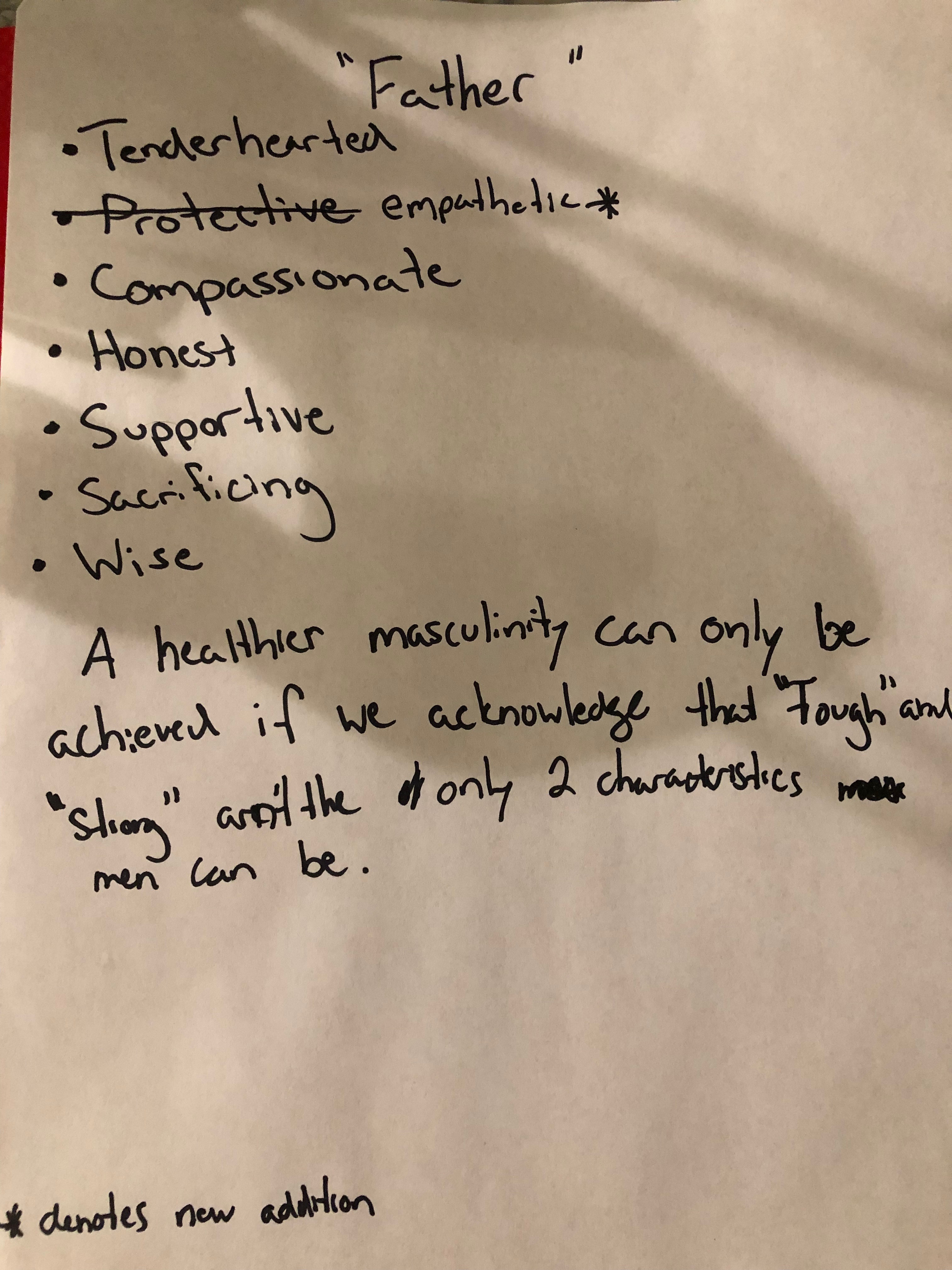
As part of a service-learning portion of an Intro to Sociology class, students were asked to take a piece of construction paper or plain white paper and mark in bold words a minimum of 5 words that best describe “mother” and “father”. We have been complicating those basic notions ever since.
Thinking about the authors we are studying assert about biology and gender, coupled with recent medical and policy developments, motherhood is more complicated than ever! The students were invited to revisit their original posters and articulate some of the information that has influenced their perspective in recent weeks. Some of their notes are below:
Words Added:
– Gender Neutral:
· The readings from this week highlighted the problems associated with gendered parenting
· Mothers struggle with work because of the perception that they are obligated to care for their home and children
· Men do not feel obligated to do any parenting work but feel an overwhelming obligation to provide economically for their families
· Both genders are equally capable of parenting in the form of motherhood and fatherhood
· everyone including children would be better off if parental duties were split equally
· All other words on the poster represent things my mother, grandparents, and stepfather did and that I wish my father had participated in
· Not parenting is a personal choice not a gendered choice
– Parent:
· Added for reasons listed above
· Parent should imply the same duties regardless of the parent’s gender
– Present:
· Being present is an essential part of parenthood that I did not think about until I watched “Glen Henry got his Superpowers Through Fatherhood”
– Care:
· “Mothering is most likely done by a female due to our society’s definition of the word ‘mother.’ The action of mothering however is simply caring for another.” [Castaneda and Oware]
– Guide
– Educate
· Guide and educate were both terms I did not think to put until I though in the context of parenthood rather than motherhood
· Gendered expectations affect us all and are very pervasive
Assertion Statement:
Replace motherhood and fatherhood with parenthood
Father
• Tenderhearted
• Empathetic
• Compassionate
• Honest
• Supportive
• Sacrificing
• Wise “A healthier masculinity can only be achieved if we acknowledge that “Tough” and “Strong” aren’t the only 2 characteristics men can be.”