Maternal and Fetal Health

In the preface to Robert Woods’ Death Before Birth (2009), he notes that “the circumstances that affect infants and children after live births are closely associated with their experience in the womb and at delivery.”  While he discussed this in a historial perspective, the topic is still very important. First, let’s take a look at Woods’ work:

Death Before Birth is the first to really tackle fetal health and mortality in a historical perspective, from the 17th to early 20th centuries. While examining an immense amount of statistics, Woods notes that interpreting records for fetal health and mortality is difficult due to the disparities in descriptions and record keeping between hospitals. Definitions become important as the lines between perinatal, neonatal, and stillbirth blur. Scandinavian nations had more thorough and accurate records in the 18th century, while Britain scantily kept records prior to 1927.

Woods notes that the turning point in maternal/fetal health and mortality is in the late 1930s and early 1940s when antibiotics became available, which reduced puerperal infection. As technology advanced, the dangers of childbirth were further reduced through the use of ultrasound, blood transfusion, prenatal care, induction for post-term pregnancies, c-section for abnormal presentation, and the professionalization of maternal staff.

0c9f3e82bbcea89b811b10f38a6afbd3

Most importantly, Woods discusses the importance of considering factors that could affect fetal loss: the skills of the birth attendant (midwives or doctors), and the health of the pregnant woman, including her social, economic, demographics, nutrition, disease environment, or even biological and genetic factors. Today, we know more about genetic and biological factors that lead to fetal loss, as they are the most common.

On August 28, 2014, Dr. Susan Stone wrote “Focus On Preventive Care As The Long-Term Strategy To Improve Health” The Huffington Post, discussing the idea that “there has been a lot of press about the rising maternal mortality rates in the United States in spite of the fact that we spend nearly $30 billion dollars a year caring for mothers and their babies.” Why is that?

Stone notes that “a contributing factor associated with many of these poor outcomes is obesity. The rising rate of obesity in the United States is affecting our health, and this is reflected in our birth outcomes. In 1962, just 13 percent of Americans were classified as obese. Today, that number is closer to 60 percent.”

Despite being a technologically advanced nation, our maternal mortality rates are slowly climbing.  Historian Robert Woods has it right when he suggests that prenatal conditions and delivery circumstances contribute to the conditions that affect an infant after a live birth. However, it can further be suggested that prenatal conditions directly correlate to the health and well being of children for their entire lives.

What do you think? Should more attention be given to getting mothers healthy and prepared for pregnancy and childbirth? Is this a global issue?

It is widely accepted that nutrition plays a vital role in the health of a growing baby….how long before a pregnancy should a woman be concerned with her own nutrition to support a growing human?

Something fun: What foods did you crave while pregnant!! (My husband is adamant I ate too many pickles. I, however, do not remember it the same way he does.)

50_lg_maternal

Meet Our Blogging Intern Naomi Rendina

Hello, everyone! I am Naomi Rendina, and am the new intern for the Museum of Motherhood! Currently, I am a PhD student at Case Western Reserve University in Cleveland, Ohio, and am studying the history of medicine. My research interests are the history of contraception, childbirth, and consumerism related to the medical and social aspects of motherhood.

10606010_10100545197851230_8306234539300589312_n-2

I have been married to an US soldier for just over six years, and we have a beautiful five year daughter who is starting kindergarten this year!

As for this blog, I am going to focus on contraception and birthing methodologies. Both of these topics currently are in the limelight, and I aim to help create material that can better educate the public on women’s issues, where they come from, and why we should support them. I want to illuminate how contraception works, how they have developed, and even social issues surrounding them.

I have noticed that there is a lot of material floating around social media sites about how to give birth. The abundance of methods creates a need for a better understanding of each so that not only are expectant couples aware of their options, but can accept other couples’ choices in how they bring their new babies into the world. Hopefully, I will get to share some of YOUR birth stories with the world through this blog! At some point, I will share my own!

Each week, I hope to bring you a short, interactive blog post that encourages discussion and provides insight. Every week, each blog will include suggestions for further reading, and links to expert and interesting websites to check out.

Please go “like” the Museum of Motherhood on FacebookInstagram, and Twitter

I look forward to writing for this blog, and hope to get to know you all a little better over the next year.

In the comment section below, please introduce yourself and make any suggestions as to what you would like to see in the blog! I would love to hear from you, and will try to answer any questions you may have.

So, what about contraception and childbirth would you like to know?

Until next time!

Naomi

Birth Stories Featuring Kim; Raising Awareness about HELLP Syndrome

It’s #FriendFriday!!!  This week I’m sharing a birth story from my friend Kim Meeks. She and her husband, George, have had an incredible journey with her daughter. Mary Farris was born at 25 weeks gestation, 15 full weeks premature. Kim shares her story here:

It was a normal pregnancy for the first 6 months.  My husband and I were thrilled about expecting our first (and only) child. We found out at 22 weeks that we would be having a girl.  We were unaware, however, that she would be born 3 weeks later.

13550893811764On May 25, 2008, I was diagnosed with HELLP syndrome, a rare and possibly fatal form of pre-eclampsia.  I was taken by ambulance from our local hospital to a St. Thomas Midtown. My husband was told that an emergency c-section was necessary to save not only my life, but to attempt to save the life of our unborn child.  Mary Farris was born at 25 weeks gestation, weighing only 1 lb. and  3oz.  She was born with a birth defect called choanal atresia.  She had no openings in the back part of her nose, and was unable to breathe on her own.  We were finally able to hold her at 54 days of age.  After 3 months on a ventilator, she pulled out the tube herself and began to breathe through her mouth.  After 148 days, Mary Farris was discharged from the NICU.  We hoped and prayed for the best life she could have, keeping in mind that having a “normal” child was highly unlikely.

She had to have a g-tube placed for nutrition related to her defect, as her mouth was her only airway.  Mary Farris was primarily tube fed until age 3 ½.  She required physical, occupational, speech and feeding therapy.  She attended a special education preschool where she could continue to receive some of these services during the school day.  She also had the benefit of 3 years of early intervention services.  In her first 5 years, she had 11 surgeries.

Last year, Mary Farris was transferred to a regular kindergarten class and is keeping up with her peers now in 1st grade.  She met all of her goals in physical therapy and was discharged, and they plan on meeting occupational therapy goals soon.  She is now 6 years old.  We felt after all of her days in the hospital, that she is partly their baby, too.  For this reason, we celebrate her birthday with the NICU staff every year.  Mary Farris says she wants to be a veterinarian when she grows up.

Through all of the experiences with Mary Farris, I have become very active in the g-tube community helping other parents adapt to their new “norm”.   I also was inspired by our experience in the NICU to go back to school.  I will graduate from nursing school in December.  Our story will come full circle when I begin my job as a NICU nurse.

Laughing Gas For Birthing Mothers? [Click to read more]

By Naomi Rendina for M.O.M.
Nitrous-Oxide-as-Labor-Drug-537x402

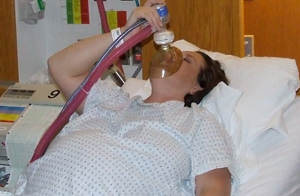
Recently, the use nitrous oxide in the delivery room has been questioned and even projected as the “next big thing” in American obstetrics. What many people are failing to recognize is that nitrous oxide has had a presence in the delivery room in the US before, and it failed to catch on. Starting in the 1880s, analgesics like chloroform or ether, were used to help take of the edge and anxieties of the birthing process. It was followed by the introduction of scopolamine, which completely knocked out a birthing woman, leaving her with no memories of her experience. By the 1950s, women were overly medicated in their birth experiences, and a backlash against the medicalization of childbirth began.

It seems as though American women are interested in the idea of laughing gas in labor. The skeptics believe the nitrous harms the baby, when, in fact, it takes one breath of room air to clear mother and fetus of nitrous. Some women find it silly that the analgesic that we’re most accustomed to in the dentist’s chair has potential in the birthing room. Other women are happy to see an alternative to pain management that is minimal, and low-risk.

The Atlantic ran an article recently, as did Slate, talking about nitrous in the delivery room.

For more information on the use of anesthesias and analgesics in the delivery room over the last 120 years or so, please see Jacqueline Wolf, Deliver Me From Pain: Anesthesia and Birth in America.34712

Do you think that re-introducing nitrous (or another inhaled analgesic) into the delivery room is a good idea? Do you think it would facilitate a movement towards more natural, de-medicalized births?

I’m looking forward to hearing your thoughts!